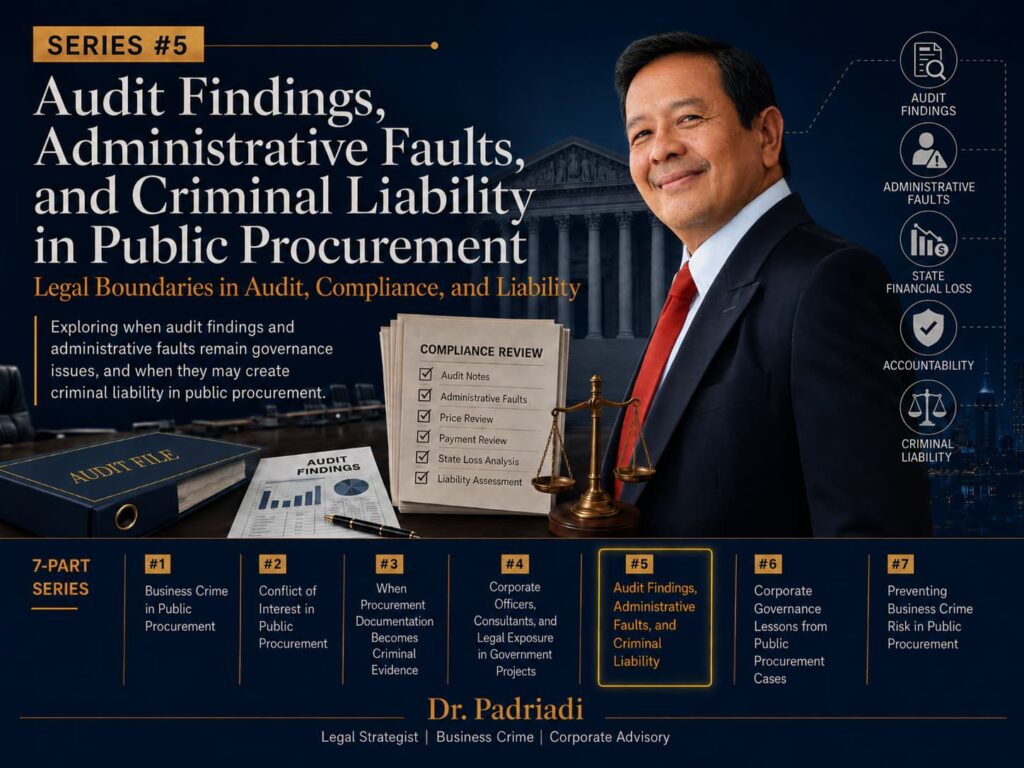
Audit Findings and Criminal Liability in Public Procurement must be understood carefully. An audit finding does not automatically mean corruption. An administrative fault does not always become a criminal offence. However, in public procurement disputes, audit findings and administrative weaknesses may become serious legal issues when they are connected to abuse of authority, state financial loss, improper benefit, or bad faith.
This article is part of the DP series on Business Crime, Public Procurement, and Corporate Legal Risk. It continues the discussion from previous articles on business crime in public procurement, conflict of interest in public procurement, procurement documentation as criminal evidence, and corporate legal exposure in government projects.
This article does not intend to treat every procurement mistake as a crime. Its purpose is to explain the legal boundary between audit findings, administrative faults, and criminal liability in public procurement.
Table of Contents
- Why Audit Findings Matter in Public Procurement
- Thesis: Audit Findings Are Necessary for Accountability
- Antithesis: Audit Findings Can Create Criminal Exposure
- Synthesis: Legal Analysis Must Separate Error from Crime
- Administrative Faults and Criminal Liability
- Lessons for Companies, Vendors, and Decision-Makers
- Conclusion
Why Audit Findings Matter in Public Procurement
Public procurement involves public money, public authority, private vendors, technical judgment, and public accountability. Because of this, audits are essential.
In Indonesia, government procurement is governed through the framework of public procurement regulations. Procurement rules are designed to support efficiency, transparency, competition, and accountability. But in practice, disputes often arise when auditors identify irregularities in planning, tender documents, pricing, specifications, delivery, payment, or contract performance.
An audit finding may identify overpricing, poor documentation, weak supervision, lack of competition, improper specifications, delay, non-compliance, or possible state financial loss.
For companies and officers involved in government projects, this is where corporate legal risk becomes urgent.
Thesis: Audit Findings Are Necessary for Accountability
The first point must be balanced. Audit findings are necessary in public procurement.
Without audit and supervision, public procurement can become vulnerable to inefficiency, waste, favoritism, manipulation, or corruption. Audits help protect public money. They also help identify whether a project was planned, tendered, implemented, and paid according to proper standards.
From a governance perspective, audit findings are not enemies of business. They are part of accountability.
The OECD Principles for Integrity in Public Procurement emphasize good governance across the entire procurement cycle, from needs assessment to contract management. The World Bank Procurement Framework also highlights procurement requirements, planning, tendering, contract management, and monitoring in government-related projects.
This is the thesis: audit findings are necessary to test accountability.
A serious company should not fear an audit. A serious company should be prepared to explain its documents, pricing, performance, communication, and compliance.
Antithesis: Audit Findings Can Create Criminal Exposure
The opposite side is also important. An audit finding may become dangerous when it is interpreted as evidence of unlawful conduct.
A finding of administrative fault may later be connected to questions of intent, benefit, abuse of authority, conflict of interest, or state financial loss. A pricing issue may become an allegation of overpricing. Weak documentation may become evidence of improper process. Poor supervision may become a question of responsibility.
The UNODC public procurement anti-corruption materials explain that public procurement can be highly vulnerable to corruption, especially in large procurements. This is why audit findings in procurement cases must be taken seriously, even when the initial issue appears administrative.
In plain terms, the problem is not the audit finding alone. The problem is what the audit findings suggest about the process, the decision, the benefit, and the loss.
This is the antithesis: audit findings can create criminal exposure.
Synthesis: Legal Analysis Must Separate Error from Crime
Under the Padriadi Dialectical Method, the legal middle path is clear: do not ignore audit findings, but do not automatically criminalize administrative errors.
A procurement process may contain mistakes. There may be weak documentation, late reporting, unclear communication, technical disagreement, or imperfect contract management. These issues may create administrative or civil consequences, but they do not automatically prove criminal liability.
Criminal liability requires a deeper legal analysis. It must examine whether there was bad faith, abuse of authority, improper benefit, conflict of interest, intentional manipulation, or a causal connection with state financial loss.
This distinction is important. If every administrative weakness is treated as corruption, public officials and companies may become afraid to make legitimate decisions. But if serious procurement manipulation is hidden behind administrative language, public money may not be protected.
The synthesis is this: legal analysis must separate error from crime.
Administrative Faults and Criminal Liability
Administrative faults may include incomplete minutes, weak market research, unclear technical specifications, poor contract supervision, delayed reporting, or failure to follow internal procedures.
These faults are serious, but they are not always criminal.
They may become legally more dangerous when combined with other factors: directed specifications, hidden vendor influence, unexplained price differences, false reporting, conflict of interest, improper payment, or evidence that certain parties received unfair benefit.
This is why evidence matters. Documents, emails, WhatsApp messages, board approvals, evaluation reports, delivery records, and audit trails may be used to understand whether the problem was a management failure or a criminal scheme.
For companies, vendors, consultants, and officers, the safest position is not to wait until an audit becomes an investigation. Procurement risk should be reviewed early as part of legal strategy and dispute risk management.
Lessons for Companies, Vendors, and Decision-Makers
The first lesson is documentation. Every major procurement decision should have a written basis.
The second lesson is pricing justification. Companies should be able to explain how prices were prepared, compared, approved, and adjusted.
The third lesson is role clarity. Officers, consultants, vendors, and project managers should know their authority and limits.
The fourth lesson is communication control. Informal communication may later become evidence if it suggests pressure, special access, or improper influence.
The fifth lesson is early legal review. In the view of Dr. Padriadi Wiharjokusumo, procurement risk is a hybrid issue: administrative, corporate, criminal, evidentiary, ethical, and strategic.
Audit Findings and Criminal Liability in Public Procurement should be managed before the matter develops into a dispute, audit controversy, investigation, or court proceeding.
Conclusion
Audit findings are important for accountability. Administrative faults are serious and must be corrected. But neither of them automatically means criminal liability.
The real legal question is whether the audit finding reveals only procedural weakness, or whether it points to abuse of authority, improper benefit, conflict of interest, bad faith, and state financial loss.
For companies, vendors, consultants, officers, and decision-makers, the lesson is clear: public procurement risk must be managed before the audit begins.
Need Legal Assessment on Audit Findings or Public Procurement Risk?
If your company, institution, or project team is dealing with audit findings, administrative faults, procurement disputes, vendor-related allegations, state financial loss issues, or business crime exposure in Indonesia, early legal assessment can help clarify the legal position before the matter develops further.
You may contact Dr. Padriadi Wiharjokusumo through DP or consult PW Law Firm for structured legal assistance in corporate, procurement, business crime, and dispute-related matters.
WhatsApp: +62 812 6327 8064
Email: pwlawfirmmedan@gmail.com
Website: https://pwlawfirmmedan.com/

LAWYERS WHO KNOW SUMATRA
About the Author
Dr. Padriadi Wiharjokusumo is an Indonesian lawyer, lecturer, and legal strategist based in Medan, North Sumatra. He focuses on corporate legal risk, public procurement, business crime, dispute strategy, governance, and legal risk assessment for companies, institutions, vendors, consultants, and decision-makers involved in government-related projects.
Through his legal writing, Dr. Padriadi combines practical legal experience, academic analysis, and corporate risk perspective to provide balanced legal insight for business and public-sector readers in Indonesia and international contexts.
Disclaimer
This article is for legal education and general information only. It does not constitute legal advice and does not determine the guilt or innocence of any party in any legal proceeding. Specific legal assessment must be based on facts, documents, applicable law, and professional consultation.
Related Topics
Audit Findings | Administrative Faults | Criminal Liability | Public Procurement | Business Crime | Corporate Legal Risk | State Financial Loss | Procurement Governance | Indonesia Law | Padriadi Wiharjokusumo