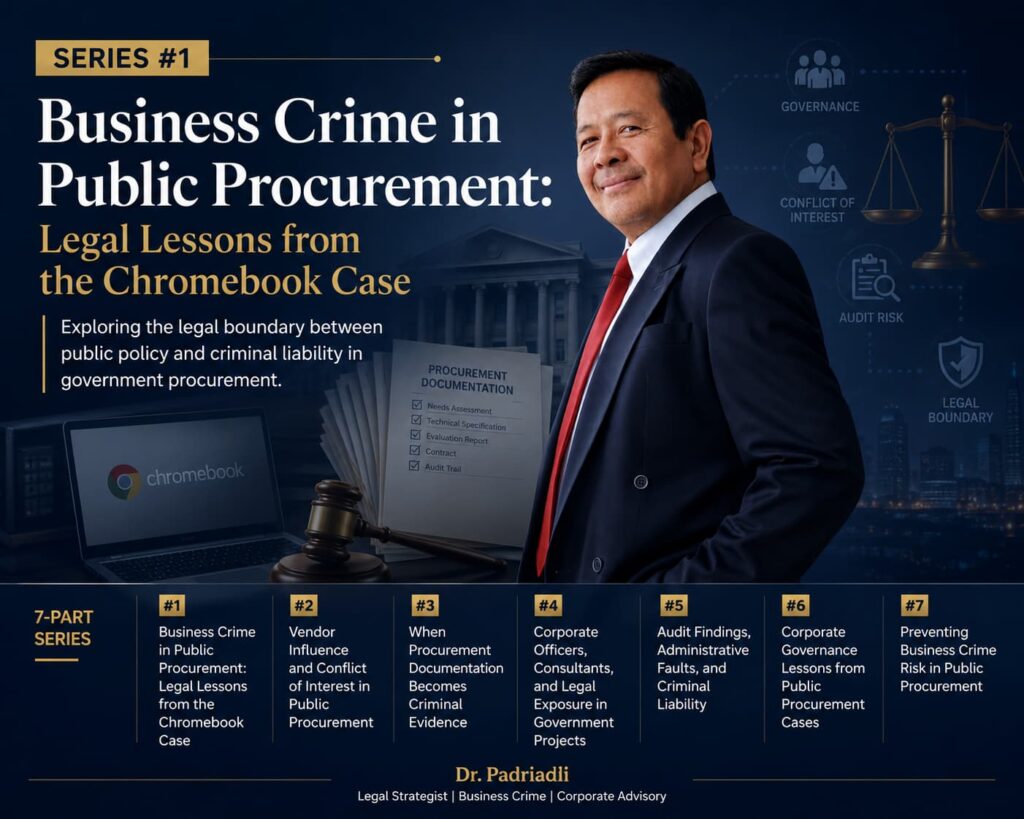
Business crime in public procurement is not only about corruption. It is also about governance, documentation, conflict of interest, vendor influence, audit risk, and the legal boundary between public policy and criminal liability.
The Chromebook case in Indonesia has become an important public discussion because it raises a difficult question: when does a public procurement decision remain a policy choice, and when can it become a business crime risk?
This article does not intend to judge any party in an ongoing legal process. The court remains the proper forum to determine guilt or innocence. However, the case provides an important legal lesson for corporations, vendors, consultants, and public decision-makers involved in government procurement.
Table of Contents
- The Chromebook Case as a Legal Learning Point
- Thesis: Public Innovation Is Necessary
- Antithesis: Procurement Can Become Business Crime Risk
- Synthesis: Governance Is the Legal Middle Path
- Business Crime in Public Procurement: Lessons for Corporations, Vendors, and Consultants
- Business Crime in Public Procurement and Legal Risk Management
- Why Early Legal Assessment Matters
- Conclusion
The Chromebook Case as a Legal Learning Point
The Chromebook case should not be read only as a political or media issue. It is better understood as a legal learning point on how public procurement can create serious risk when technology, public money, vendor ecosystems, and administrative discretion meet in one project.
In Indonesia, government procurement is regulated through the framework of public procurement regulations. But legal compliance in procurement is not only about following formal procedures. It is also about whether the process is transparent, competitive, well-documented, and free from improper influence.
For companies and consultants, this is where corporate legal risk begins. A project may look commercial at the beginning but later become criminal, civil, or administrative when auditors, investigators, or courts examine the decision-making process.
Thesis: Public Innovation Is Necessary
The first point must be fair. Public institutions need innovation. Digital education, technology procurement, and modernization of public services are legitimate public goals.
A government should not be afraid to adopt technology merely because a project is large or complex. In a country as large as Indonesia, digital tools may help reduce educational inequality, improve access, and support public service delivery.
From this perspective, procurement is not automatically suspicious. A technology-based procurement project can be lawful, necessary, and beneficial if it is based on real needs, proper assessment, open competition, and accountable decision-making.
This is the thesis: public innovation is necessary.
Antithesis: Procurement Can Become Business Crime Risk
The opposite side is equally important. Public procurement can become a business crime risk when the process loses neutrality.
Risk may arise when technical specifications appear to favor a certain product, platform, vendor, or ecosystem. It may also arise when consultants or private actors influence policy design beyond a proper professional role. The issue becomes more serious when pricing, suitability, user needs, and state financial loss become disputed.
Internationally, public procurement is recognized as a high-risk area because it involves public money, private vendors, technical discretion, and complex decision-making. The OECD’s integrity in public procurement framework emphasizes the need to address fraud, collusion, corruption, undue influence, and unethical practices across the procurement cycle. The World Bank Procurement Framework also highlights the importance of planning, tendering, contract management, and monitoring in government-funded projects. Similarly, the UNODC guidebook on anti-corruption in public procurement connects procurement integrity with transparency, competition, and objective decision-making.
In business crime analysis, the legal danger is not always a direct bribe. Sometimes, the risk comes from a chain of decisions that creates the appearance of favoritism, weak documentation, or unfair advantage.
This is the antithesis: procurement can become a business crime risk.
Synthesis: Governance Is the Legal Middle Path
The answer is not to reject innovation. The answer is stronger procurement governance.
This is the synthesis under the Padriadi Dialectical Method: Indonesia needs digital innovation, but public innovation must be protected by law, ethics, documentation, and accountability.
In practical terms, procurement governance means clear need assessment, neutral specifications, transparent market research, conflict of interest declarations, proper minutes of meetings, audit trails, and legal review before decisions are executed.
A wrong policy is not automatically a crime. But when a wrong policy is connected with abuse of authority, benefit to certain parties, lack of accountability, and state financial loss, the legal risk becomes much more serious.
This is why the boundary between policy failure and corruption must be examined carefully. Legal analysis must avoid two extremes: criminalizing every policy mistake or ignoring procurement manipulation merely because it is wrapped in administrative language.
Business Crime in Public Procurement should therefore be understood as a governance warning, not merely as a criminal law issue.
Business Crime in Public Procurement: Lessons for Corporations, Vendors, and Consultants
For corporations, vendors, and consultants, the main lesson is simple: do not treat public procurement as an ordinary commercial transaction.
A private company involved in a government project must manage its communication, documents, pricing structure, technical proposal, and internal approvals carefully. A consultant must also understand the limits of their role. Giving technical advice is one thing. Becoming a shadow decision-maker is another.
Companies should maintain written records of meetings, avoid informal commitments, disclose potential conflicts of interest, and ensure that their proposal does not depend on unfair access to decision-makers.
This is also why Dr. Padriadi Wiharjokusumo emphasizes corporate legal risk not only as litigation risk but as a governance issue. A company may win a tender today, but face investigation tomorrow if the process cannot be explained clearly.
Business Crime in Public Procurement and Legal Risk Management
Business Crime in Public Procurement requires careful legal risk management because procurement decisions may later be reviewed by auditors, investigators, or courts. For corporations, vendors, and consultants, strong documentation, transparent communication, and early legal assessment are essential to reduce criminal, civil, administrative, and reputational exposure.
Why Early Legal Assessment Matters in Business Crime in Public Procurement
Business Crime in Public Procurement often becomes dangerous because legal assessment comes too late.
By the time an audit finding, summons, investigation, or public controversy appears, the documents may already be incomplete, the communication trail may be unclear, and the company’s legal position may be difficult to explain.
Early legal assessment helps identify whether a procurement process has exposure to criminal, civil, administrative, or reputational risk. It also helps companies review contracts, correspondence, tender documents, pricing assumptions, internal approvals, and compliance procedures.
For businesses involved in government projects in Indonesia, structured legal assistance from PW Law Firm may help clarify their legal position before risks develop further.
Business Crime in Public Procurement may develop from weak planning, unclear communication, poor documentation, and unmanaged vendor influence.
Conclusion
The Chromebook case is not just about laptops. It is a reminder that public procurement is a high-risk legal environment where policy, business, technology, and public money intersect.
Indonesia needs innovation. But innovation must be supported by procurement governance, legal clarity, ethical decision-making, and corporate compliance.
For corporations, vendors, consultants, and public decision-makers, the lesson is clear: in public procurement, legal risk does not begin in court. It begins in planning, communication, specification, pricing, documentation, and governance.
Need a legal assessment on procurement or business crime risk?
If your company, institution, or project team is dealing with procurement-related legal risk, audit findings, vendor-related allegations, or business crime exposure in Indonesia, early legal assessment can help clarify the legal position before the matter develops into criminal, civil, or administrative proceedings.
You may contact Dr. Padriadi Wiharjokusumo through DP or consult PW Law Firm for structured legal assistance in corporate, procurement, business crime, and dispute-related matters.
Disclaimer
This article is for legal education and general information only. It does not constitute legal advice and does not intend to determine the guilt or innocence of any party in an ongoing legal proceeding. Any legal assessment must be based on specific facts, documents, applicable law, and professional consultation.
Author
Dr. Padriadi Wiharjokusumo is a lawyer, lecturer, and international legal strategist focusing on corporate legal risk, public procurement, business crime, dispute strategy, and governance-related legal issues in Indonesia.
LAWYERS WHO KNOW SUMATRA
Related Topics
Business Crime | Public Procurement | Corporate Legal Risk | Procurement Governance | Anti-Corruption | Legal Risk Management | Indonesia Law | Corporate Compliance | Dispute Strategy | Padriadi Wiharjokusumo