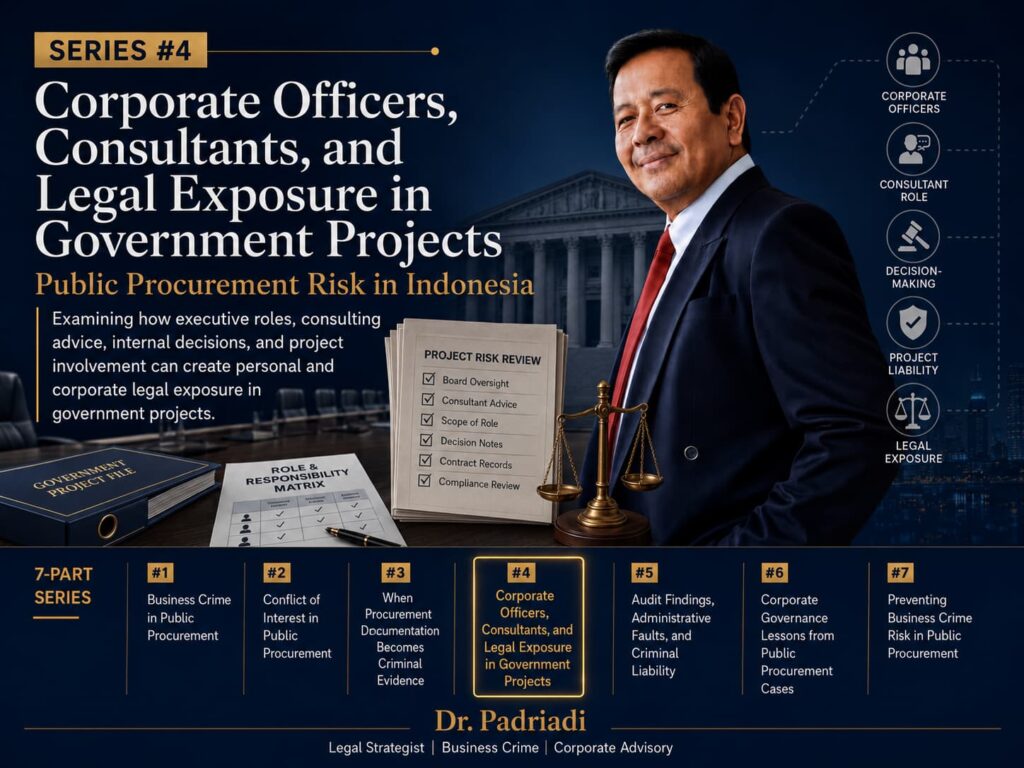
Corporate legal exposure in government projects is not limited to the company as a legal entity. In public procurement and government-related projects, individual roles may also become legally sensitive. Directors, commissioners, corporate officers, consultants, project managers, advisers, and decision-makers may face legal exposure when their actions, advice, communication, or decisions are connected to a disputed government project.
This article is part of the DP series on Business Crime, Public Procurement, and Corporate Legal Risk. It continues the discussion from the previous articles on business crime in public procurement, conflict of interest in public procurement, and procurement documentation as criminal evidence.
This article does not suggest that every officer, consultant, or vendor involved in a government project is legally at risk. The purpose is to explain why role clarity, documentation, and governance are essential in public procurement and government projects.
Table of Contents
- Why Corporate Legal Exposure in Government Projects Matters
- Thesis: Corporate Officers and Consultants Are Necessary
- Antithesis: Roles Can Create Legal Exposure
- Synthesis: Role Clarity as Legal Protection
- Legal Exposure for Corporate Officers
- Legal Exposure for Consultants and Advisers
- Conclusion
Why Corporate Legal Exposure in Government Projects Matters
Government projects often involve many actors. A company may participate as a vendor, contractor, supplier, service provider, or project partner. Inside the company, directors and officers may approve proposals, sign contracts, supervise implementation, authorize payments, or communicate with public officials.
At the same time, consultants may provide technical advice, market information, project design, legal input, financial analysis, or implementation support.
In Indonesia, public procurement is governed through public procurement regulations. But in practice, legal risk is not only found in the formal procurement document. It may also appear in the roles played by individuals before, during, and after the procurement process.
For corporations, this is where corporate legal risk becomes personal, strategic, and evidentiary.
Thesis: Corporate Officers and Consultants Are Necessary
The first point must be fair. Government projects cannot operate without corporate participation and professional advice.
Corporate officers are needed to make business decisions, approve participation, ensure performance, allocate resources, and protect the company’s interests. Consultants are also needed because government projects often involve complex technical, financial, legal, and operational issues.
In technology, infrastructure, healthcare, education, and public service projects, decision-makers may need expert input. A consultant may help explain market conditions. A corporate officer may help structure a proposal. A project manager may coordinate delivery and compliance.
This is the thesis: corporate officers and consultants are necessary in government projects.
Their involvement is not automatically suspicious. In many cases, their involvement helps the project become more professional, efficient, and accountable.
Antithesis: Roles Can Create Legal Exposure
The opposite side is also important. A necessary role can become a risky role when the boundary is unclear.
A corporate officer may face legal exposure if they approve a proposal without proper review, ignore red flags, allow improper communication, or sign documents that later become problematic. A consultant may face exposure if their advice appears to influence public decision-making beyond a professional advisory role.
The OECD Principles for Integrity in Public Procurement emphasize integrity, transparency, and accountability across the procurement cycle. The World Bank Procurement Framework also highlights the importance of planning, tendering, contract management, and monitoring in government-related procurement. The UNODC discussion on corruption in public procurement explains how procurement risks may arise when public benefits are diverted through improper decision-making, collusion, or conflicts of interest.
In plain terms, legal exposure may arise not only from receiving money or giving instructions. It may also arise from approving, recommending, facilitating, ignoring, documenting, or failing to prevent a risky decision.
This is the antithesis: roles can create legal exposure.
Synthesis: Role Clarity as Legal Protection
Under the Padriadi Dialectical Method, the legal middle path is not to avoid government projects. The answer is role clarity.
Every actor must understand the scope of their authority and responsibility. A director should know whether they are approving a business decision, supervising compliance, or merely receiving a report. A consultant should know whether they are giving neutral advice or shaping a decision. A project manager should know whether they are implementing a contract or making strategic commitments.
Role clarity protects both individuals and corporations.
It helps explain who made the decision, who gave advice, who approved documents, who communicated with public officials, and who had authority over the project. Without role clarity, legal responsibility may become blurred. When responsibility is blurred, investigators, auditors, courts, and counterparties may interpret the facts differently.
This is why a role and responsibility matrix, board minutes, internal approvals, consultant engagement letters, project instructions, and compliance notes are not merely administrative tools. They are legal protection.
Legal Exposure for Corporate Officers
Corporate officers may face several types of exposure in government projects.
First, there is decision-making exposure. This may arise when officers approve tender participation, pricing strategy, project documents, or contract execution without sufficient legal and compliance review.
Second, there is supervisory exposure. Senior officers may be questioned if a company fails to supervise employees, agents, or consultants involved in public procurement.
Third, there is documentation exposure. If internal approvals, board decisions, or risk assessments are incomplete, it may be difficult to prove that a decision was made in good faith.
Fourth, there is communication exposure. Emails, messages, meeting notes, presentations, and informal discussions may later be reviewed as part of the evidence trail.
This is why corporate officers should treat government projects as high-risk transactions requiring structured legal review, not ordinary commercial opportunities.
Legal Exposure for Consultants and Advisers
Consultants and advisers also need caution.
A consultant may be legally safe when the role is clear, professional, neutral, and documented. However, risk may arise when the consultant influences specifications, connects private interests with public decision-makers, prepares documents beyond the agreed scope, or becomes too involved in internal government decisions.
The danger is role confusion. A consultant may begin as an adviser but later be seen as a hidden decision-maker or facilitator.
For this reason, consultant agreements should define scope of work, reporting lines, confidentiality, conflict of interest rules, communication protocols, and limits of authority.
In the view of Dr. Padriadi Wiharjokusumo, procurement risk is a hybrid legal issue: corporate, administrative, criminal, evidentiary, ethical, and strategic. It should be managed before a dispute, audit, or investigation appears.
Conclusion
Corporate officers and consultants are necessary in government projects. But their roles must be clear, documented, and accountable.
Legal exposure in public procurement does not always begin with a criminal act. Sometimes, it begins with unclear authority, undocumented advice, weak supervision, careless approval, or informal communication.
For companies, vendors, consultants, and decision-makers, the lesson is clear: role clarity is not only good management. It is legal protection.
Corporate Legal Exposure in Government Projects should be managed before disputes, audits, or investigations appear.
Need Legal Assessment on Government Project or Procurement Risk?
If your company, institution, or project team is dealing with government project risk, consultant involvement, officer liability, procurement disputes, audit findings, or business crime exposure in Indonesia, early legal assessment can help clarify the legal position before the matter develops further.
You may contact Dr. Padriadi Wiharjokusumo through DP or consult PW Law Firm for structured legal assistance in corporate, procurement, business crime, and dispute-related matters.
WhatsApp: +62 812 6327 8064
Email: pwlawfirmmedan@gmail.com
Website: https://pwlawfirmmedan.com/

LAWYERS WHO KNOW SUMATRA
Disclaimer
This article is for legal education and general information only. It does not constitute legal advice and does not determine the guilt or innocence of any party in any legal proceeding. A specific legal assessment must be based on facts, documents, applicable law, and professional consultation.
Author
Dr. Padriadi Wiharjokusumo is a lawyer, lecturer, and international legal strategist focusing on corporate legal risk, public procurement, business crime, dispute strategy, and governance-related legal issues in Indonesia.
Related Topics:
Corporate Officers | Consultants | Legal Exposure | Government Projects | Public Procurement | Business Crime | Corporate Legal Risk | Consultant Liability | Indonesia Law | Padriadi Wiharjokusumo