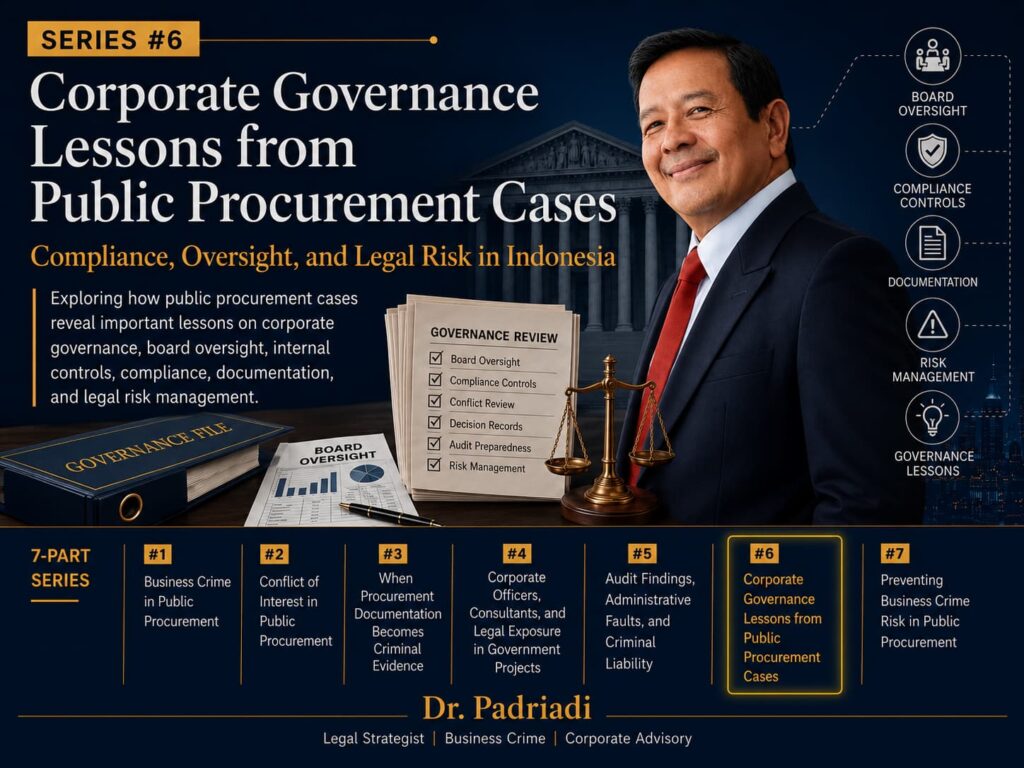
Corporate Governance Public Procurement lessons are important for companies, vendors, consultants, and decision-makers involved in government-related projects in Indonesia.
Corporate Governance Lessons from Public Procurement Cases are important for companies, vendors, consultants, and decision-makers involved in government-related projects. Public procurement is not only a government process. It is also a corporate governance test for every private actor who enters the public sector market.
When procurement problems arise, the legal issue is often not limited to the tender document or the contract. Investigators, auditors, courts, shareholders, and the public may also examine how the company made decisions, supervised officers, managed consultants, controlled communication, reviewed pricing, and documented compliance.
This article is part of the DP series on Business Crime, Public Procurement, and Corporate Legal Risk. It continues the discussion from previous articles on business crime in public procurement, conflict of interest in public procurement, procurement documentation as criminal evidence, corporate legal exposure in government projects, and audit findings and criminal liability in public procurement.
Table of Contents
- Why Corporate Governance Matters in Public Procurement
- Thesis: Business Needs Access to Government Projects
- Antithesis: Weak Governance Creates Legal Exposure
- Synthesis: Governance as Legal Risk Protection
- Corporate Governance Lessons for Companies
- Practical Controls Before a Procurement Dispute
- Conclusion
Why Corporate Governance Matters in Public Procurement
Public procurement involves public money, private business interests, technical discretion, and legal accountability. For that reason, it requires more than commercial ambition. It requires governance.
In Indonesia, public procurement is regulated through the framework of government procurement regulations, including later regulatory developments in the procurement framework. But corporate risk does not end with formal compliance. A company must also be able to show that its internal decisions were made properly, reviewed responsibly, and documented clearly.
The OECD Principles for Integrity in Public Procurement emphasize good governance throughout the procurement cycle, from needs assessment to contract management. The World Bank Procurement Framework also highlights value for money, efficiency, transparency, and fairness in government-related procurement. These principles are relevant for corporations because public procurement risk often enters the company through pricing, communication, documentation, and oversight.
For companies, this is where corporate legal risk becomes a governance issue.
Thesis: Business Needs Access to Government Projects
The first point must be realistic. Companies need access to government projects.
Government procurement creates opportunities for vendors, suppliers, contractors, consultants, technology providers, and professional service firms. It supports infrastructure, education, healthcare, digital transformation, public services, and economic development.
A company should not avoid public procurement merely because it carries legal risk. With proper governance, government-related projects can be legitimate, profitable, and beneficial for society.
This is the thesis: business needs access to government projects.
Corporate governance should not be understood as a barrier to business. It should be understood as the system that allows business to enter public-sector projects safely and responsibly.
Antithesis: Weak Governance Creates Legal Exposure
The opposite side is also important. Public procurement becomes dangerous when a company has weak governance.
Legal exposure may arise when officers approve projects without proper review, consultants operate without clear limits, pricing cannot be justified, communication with public officials is informal, conflicts of interest are not declared, or documents are prepared only after problems appear.
The UNODC public procurement anti-corruption materials explain that public procurement is vulnerable to corruption, especially in large procurements. For companies, this means that public procurement should never be treated as an ordinary sales opportunity.
Weak governance may turn a business opportunity into a legal problem. A company may later be asked to explain who made the decision, who approved the price, who communicated with officials, who supervised consultants, and whether warning signs were ignored.
This is the antithesis: weak governance creates legal exposure.
Synthesis: Governance as Legal Risk Protection
Under the Padriadi Dialectical Method, the legal middle path is not to reject government projects. The answer is stronger corporate governance.
Governance protects the company before a dispute appears. It helps separate legitimate business activity from improper influence. It also helps show that the company acted with good faith, internal review, proper authority, and documented compliance.
Good governance means that the company has clear rules for approving tender participation, communicating with public officials, appointing consultants, setting prices, managing conflicts of interest, documenting meetings, and responding to audit findings.
This is the synthesis: governance is legal risk protection.
A company with strong governance may still face questions. But it will have a stronger position to explain its decisions.
Corporate Governance Lessons for Companies
Several lessons can be drawn from public procurement cases.
First, board and management oversight must be real. Public procurement should be treated as a high-risk transaction, not merely a sales opportunity.
Second, role clarity is essential. Directors, officers, consultants, project managers, and agents must understand their authority and limits.
Third, conflict of interest control must be documented. It is not enough to say there was no conflict. The company should have declarations, review notes, and approval records.
Fourth, pricing must be explainable. Price proposals, margins, discounts, market comparisons, and cost assumptions should be supported by records.
Fifth, communication must be controlled. Emails, messages, meeting notes, and presentations may later become part of the evidence trail.
Sixth, consultant engagement must be structured. Consultants should have clear scope of work, reporting lines, confidentiality obligations, and conflict of interest rules.
These are not only compliance steps. They are legal protection.
Practical Controls Before a Procurement Dispute
Companies involved in government projects should build practical controls before problems arise.
They should prepare a procurement risk checklist, legal review note, pricing justification file, conflict of interest declaration, communication protocol, document retention policy, consultant engagement review, and internal approval matrix.
They should also train business development teams. Many procurement problems begin before lawyers are involved: in early meetings, informal communications, product presentations, pricing discussions, and relationship-building.
This is why procurement-related matters should be reviewed early as part of legal strategy and dispute risk management.
In the view of Dr. Padriadi Wiharjokusumo, procurement risk is a hybrid issue: corporate, administrative, criminal, evidentiary, ethical, and strategic. It should be managed before an audit, investigation, or dispute appears.
Conclusion
Public procurement cases provide an important lesson for corporate governance. The legal risk does not begin when an investigation starts. It begins when a company decides to enter a government project.
Companies need access to public-sector opportunities. But access must be supported by governance, documentation, role clarity, compliance, and legal review.
Corporate Governance Lessons from Public Procurement Cases are clear: a company that manages governance early is better prepared to face audit questions, legal disputes, reputational risk, and business crime exposure.
Need Legal Assessment on Corporate Governance or Public Procurement Risk?
If your company, institution, or project team is dealing with public procurement risk, governance weaknesses, consultant involvement, audit findings, vendor-related allegations, or business crime exposure in Indonesia, early legal assessment can help clarify the legal position before the matter develops further.
You may contact Dr. Padriadi Wiharjokusumo through DP or consult PW Law Firm for structured legal assistance in corporate, procurement, business crime, and dispute-related matters.
WhatsApp: +62 812 6327 8064
Email: pwlawfirmmedan@gmail.com
Website: https://pwlawfirmmedan.com/
LAWYERS WHO KNOW SUMATRA
Disclaimer
This article is for legal education and general information only. It does not constitute legal advice and does not determine the guilt or innocence of any party in any legal proceeding. Specific legal assessment must be based on facts, documents, applicable law, and professional consultation.
Author
Dr. Padriadi Wiharjokusumo is an Indonesian lawyer, lecturer, and legal strategist based in Medan, North Sumatra, Indonesia. His work focuses on corporate legal risk, public procurement, business crime, dispute strategy, and governance-related legal issues in Indonesia.
Related Topics
Corporate Governance | Public Procurement | Business Crime | Corporate Legal Risk | Procurement Compliance | Governance Lessons | Consultant Risk | Audit Findings | Indonesia Law | Padriadi Wiharjokusumo