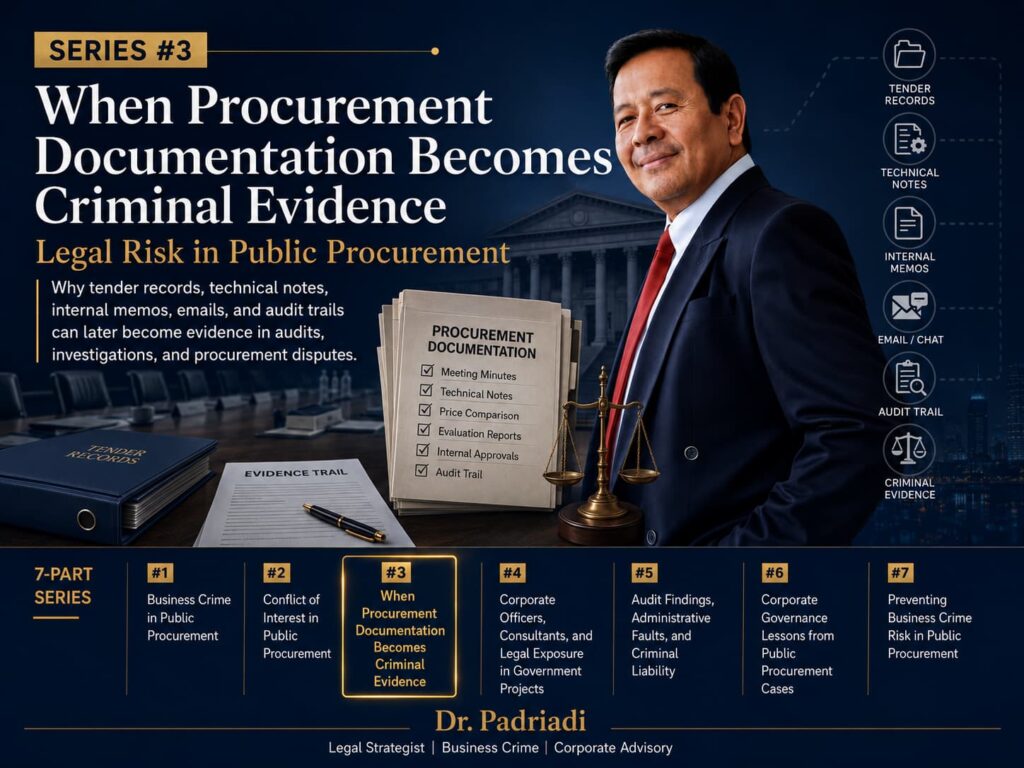
Procurement documentation criminal evidence risk is a serious legal issue in public procurement disputes.
The use of procurement documentation as criminal evidence is a serious legal issue in public procurement disputes. Many companies, vendors, consultants, and decision-makers still treat procurement documents as ordinary administrative records. In reality, those documents may later become legal evidence in an audit, investigation, criminal case, civil dispute, or administrative review.
This article is part of the DP series on Business Crime, Public Procurement, and Corporate Legal Risk. It continues the discussion from the previous articles on business crime in public procurement and conflict of interest in public procurement.
The purpose of this article is not to suggest that every procurement mistake is a crime. The purpose is to explain why documentation must be treated as a legal risk management tool from the beginning of the procurement process.
Table of Contents
- Why Procurement Documentation Matters
- Thesis: Documentation Protects the Procurement Process
- Antithesis: Documentation Can Become Criminal Evidence
- Synthesis: Audit Trail as Legal Protection
- Documents That May Become Evidence
- Lessons for Vendors, Consultants, and Decision-Makers
- Conclusion
Procurement Documentation: Criminal Evidence Risk in Public Procurement
Public procurement is not only about purchasing goods or services. It is a legal process involving public money, public authority, private vendors, technical judgment, and accountability.
In Indonesia, public procurement is regulated under the government procurement framework, including Presidential Regulation No. 16 of 2018 on Government Procurement of Goods/Services, as amended by Presidential Regulation No. 12 of 2021 and Presidential Regulation No. 46 of 2025, together with technical procurement rules and guidance issued by the relevant authorities.
However, legal risk often appears when the written record does not clearly explain why a decision was made. A procurement decision may be reasonable in substance, but if the documentation is weak, incomplete, inconsistent, or contradictory, the decision may later appear suspicious.
For companies, vendors, consultants, and project stakeholders, this is where corporate legal risk begins.
Thesis: Documentation Protects the Procurement Process
The first point is simple: documentation protects everyone.
Good documentation helps public officials explain the basis of a procurement decision. It helps vendors prove that their proposal was submitted properly. It helps consultants show the limits of their technical advice. It also helps auditors reconstruct the procurement process objectively.
In a healthy procurement process, documents are not merely formalities. They are the legal memory of the project.
Meeting minutes, technical notes, price comparisons, evaluation reports, internal approvals, market research, and correspondence can show that decisions were based on objective reasons, not hidden influence or improper benefit.
This is the thesis: documentation is a protection mechanism.
Without proper documentation, even a lawful decision may become difficult to defend.
Antithesis: Documentation Can Become Criminal Evidence
The opposite side is more dangerous. The same documents that protect a procurement process may also become evidence against the parties involved.
A meeting record may show who influenced a decision. A technical specification may show whether a tender was neutral or directed toward a certain vendor. A pricing document may show whether there was overpricing. An email or WhatsApp message may reveal informal commitments, special access, pressure, or coordination outside the formal procurement process.
The OECD Principles for Integrity in Public Procurement explain the importance of transparency and integrity throughout the procurement cycle. The World Bank Procurement Framework also emphasizes procurement requirements, planning, tendering, contract management, and monitoring in projects involving government borrowers. The UNODC discussion on corruption in public procurement explains that public procurement is particularly vulnerable to collusion, cartel practices, and other conduct that may prevent value for money.
In plain terms, procurement documents can answer two opposite questions:
Were the procurement decisions lawful, objective, and accountable?
Or did the documents reveal inconsistency, hidden influence, weak justification, or improper benefit?
This is the antithesis: documentation can become criminal evidence.
Synthesis: Audit Trail as Legal Protection
Under the Padriadi Dialectical Method, the answer is not to fear documentation. The answer is to build a strong audit trail.
The legal middle path is clear: every important decision must be documented, but the documentation must be honest, complete, consistent, and explainable.
An audit trail should show the sequence of procurement decisions from planning to implementation. This includes need assessment, technical input, market consultation, tender preparation, evaluation, contract award, implementation, payment, monitoring, and project closure.
A strong audit trail does not guarantee that there will be no dispute. But it makes the legal position easier to explain. It helps separate policy error from bad faith, administrative weakness from criminal intent, and technical disagreement from procurement manipulation.
This is why procurement documentation must be prepared not only for internal filing but also for possible review by auditors, investigators, courts, shareholders, or the public.
Documents That May Become Evidence
In procurement-related disputes, several types of documents may become important evidence.
These include tender documents, terms of reference, technical specifications, evaluation reports, meeting minutes, internal memos, market research, price comparison records, correspondence with vendors, consultant reports, payment records, delivery documents, and audit findings.
Digital communication may also matter. Emails, chat messages, file metadata, shared documents, electronic approvals, and revised draft files can become part of the evidence trail.
For vendors and consultants, the most sensitive documents are often the earliest ones: presentation materials, technical input, informal communication, draft specifications, and meeting notes before the tender is formally announced.
This is where many legal problems begin.
A document created before the formal procurement stage may later be used to question whether a tender was genuinely competitive or whether the procurement structure had already been directed toward a certain outcome.
Lessons for Vendors, Consultants, and Decision-Makers
For vendors, the key lesson is to document communication clearly and avoid informal commitments that may later be misunderstood.
For consultants, the key lesson is to define the scope of advice. A consultant should not quietly become a shadow decision-maker. Technical input must be professional, neutral, and properly recorded.
For public decision-makers, the key lesson is to ensure that every major procurement decision has a written basis. If a decision cannot be explained through documents, it may become legally vulnerable.
This is why procurement-related matters should be reviewed early as part of legal strategy and dispute risk management, not only after an investigation begins.
In the view of Dr. Padriadi Wiharjokusumo, procurement risk is a hybrid legal issue. It involves administrative law, corporate responsibility, criminal exposure, evidentiary risk, ethical governance, and strategic decision-making.
Conclusion
Procurement documentation is not merely paperwork. It is the legal memory of a government project.
The same document can protect a company, consultant, or decision-maker. But the same document can also become criminal evidence if it shows inconsistency, hidden influence, weak justification, or improper benefit.
For anyone involved in public procurement, the lesson is clear:
Legal risk begins before the contract is signed.
Evidence begins before the dispute appears.
Need Legal Assessment on Procurement Documentation or Business Crime Risk?
If your company, institution, or project team is dealing with procurement documentation, audit findings, vendor-related allegations, conflict of interest concerns, or business crime exposure in Indonesia, early legal assessment can help clarify the legal position before the matter develops further.
You may contact Dr. Padriadi Wiharjokusumo through DP or consult PW Law Firm for structured legal assistance in corporate, procurement, business crime, and dispute-related matters.
WhatsApp: +62 812 6327 8064
Email: pwlawfirmmedan@gmail.com
Website: https://pwlawfirmmedan.com/
Disclaimer
This article is for legal education and general information only. It does not constitute legal advice and does not determine the guilt or innocence of any party in any ongoing legal proceeding. Specific legal assessment must be based on facts, documents, applicable law, and professional consultation.
Author
Dr. Padriadi Wiharjokusumo is a lawyer, lecturer, and international legal strategist focusing on corporate legal risk, public procurement, business crime, dispute strategy, and governance-related legal issues in Indonesia.
LAWYERS WHO KNOW SUMATRA
Related Topics:
Procurement Documentation | Criminal Evidence | Public Procurement | Business Crime | Corporate Legal Risk | Audit Trail | Procurement Governance | Vendor Risk | Indonesia Law | Padriadi Wiharjokusumo