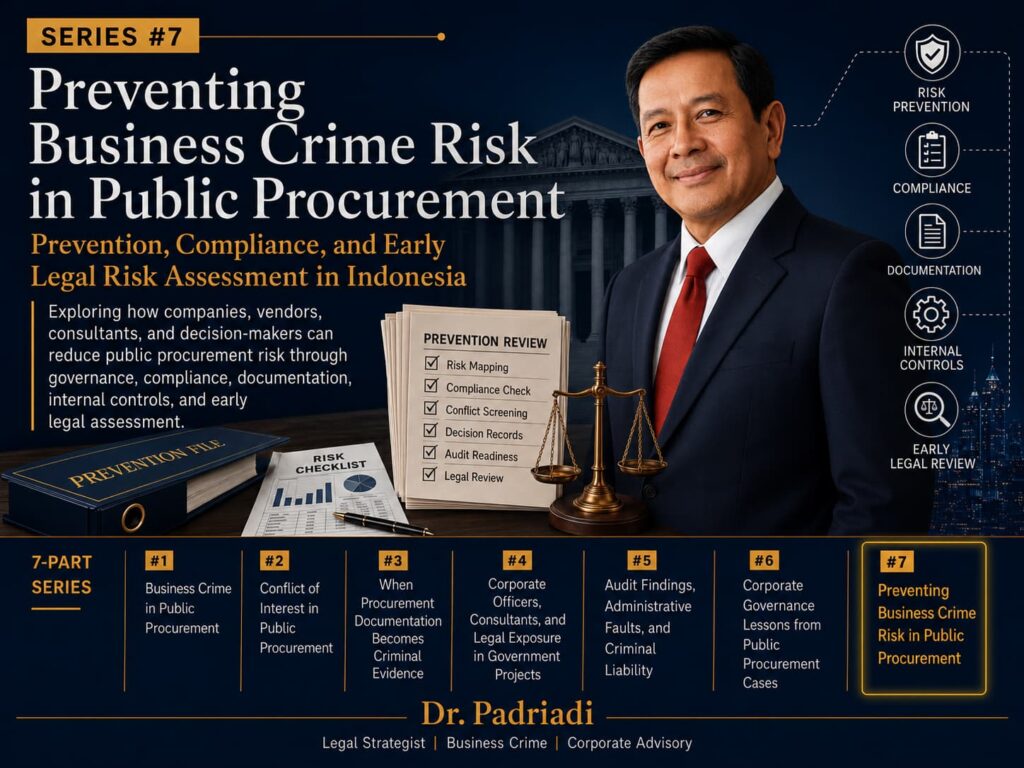
Preventing Business Crime Risk in Public Procurement is not only a legal issue.
Preventing Business Crime Risk in Public Procurement is not only a legal issue. It is also a governance, compliance, documentation, and leadership issue. For companies, vendors, consultants, and decision-makers involved in government-related projects, prevention must begin before a tender is submitted, before a contract is signed, and before an audit or investigation appears.
This article is the final part of the DP series on Business Crime, Public Procurement, and Corporate Legal Risk. It concludes the discussion from previous articles on business crime in public procurement, conflict of interest in public procurement, procurement documentation as criminal evidence, corporate legal exposure in government projects, audit findings and criminal liability in public procurement, and corporate governance lessons from public procurement cases.
The purpose of this article is not to create fear toward public procurement. The purpose is to explain how legal risk can be reduced through early prevention, clear roles, proper documentation, compliance controls, and strategic legal assessment.
Table of Contents
- Why Prevention Matters in Public Procurement
- Thesis: Public Procurement Creates Business Opportunities
- Antithesis: Public Procurement Also Creates Business Crime Risk
- Synthesis: Prevention as the Legal Middle Path
- Practical Prevention Framework for Companies
- Early Legal Assessment Before the Risk Develops
- Conclusion
Why Prevention Matters in Public Procurement
Public procurement is a high-risk legal environment because it involves public money, private business interests, technical discretion, public authority, and accountability.
In Indonesia, government procurement is governed through public procurement regulations, including the procurement framework developed under Perpres No. 16 of 2018 as amended by Perpres No. 12 of 2021. These rules seek to support transparency, competition, efficiency, and accountability in government procurement.
However, formal compliance alone is not enough. In many procurement disputes, the legal problem is not only whether a document exists. The deeper question is whether the process can be explained: who made the decision, who gave advice, who approved the price, who communicated with public officials, and whether conflicts of interest were properly managed.
For companies, this is where corporate legal risk must be prevented early.
Thesis: Public Procurement Creates Business Opportunities
The first point must be fair. Public procurement creates legitimate business opportunities.
Government projects need vendors, contractors, consultants, technology providers, suppliers, and professional service firms. Public procurement can support infrastructure, education, healthcare, digital transformation, and public services.
A company should not automatically avoid public procurement because of legal risk. With proper governance, public procurement can be lawful, profitable, and socially useful.
This is the thesis: public procurement creates business opportunities.
Business should be allowed to support public needs. But business must enter government projects with discipline, documentation, and legal awareness.
Antithesis: Public Procurement Also Creates Business Crime Risk
The opposite side is equally important. Public procurement can also create business crime risk.
Risk may arise from conflict of interest, vendor influence, directed specifications, pricing issues, weak documentation, improper communication, consultant role confusion, poor supervision, audit findings, or allegations of state financial loss.
The OECD Principles for Integrity in Public Procurement emphasize integrity and good governance across the procurement cycle, from needs assessment to contract management. The World Bank Procurement Framework also highlights value for money, fairness, transparency, and accountability in government-related procurement. The UNODC public procurement anti-corruption materials explain that public procurement is vulnerable to corruption, especially where large public funds and private interests meet.
In plain terms, the risk does not always begin with bribery. It may begin with weak governance, unclear communication, undocumented advice, or decisions that cannot be explained later.
This is the antithesis: public procurement can create business crime risk.
Synthesis: Prevention as the Legal Middle Path
Under the Padriadi Dialectical Method, the answer is not to reject public procurement. The answer is prevention.
Prevention is the legal middle path between business opportunity and business crime risk.
Companies should not wait until an audit, summons, investigation, or media controversy appears. By that time, documents may be incomplete, communication may be unclear, and the company’s legal position may already be difficult to defend.
Prevention means building systems before the risk develops. It means mapping risk, clarifying roles, recording decisions, controlling communication, reviewing pricing, screening conflicts of interest, and obtaining legal assessment before entering sensitive government projects.
This is the synthesis: prevention is not fear. Prevention is legal protection.
Practical Prevention Framework for Companies
A practical prevention framework should include several basic controls.
First, companies need a procurement risk mapping process. Before joining a government project, the company should identify legal, financial, reputational, administrative, and criminal exposure.
Second, companies need conflict of interest screening. Any personal, commercial, institutional, or relational connection that may affect neutrality must be identified and documented.
Third, companies need clear role allocation. Directors, officers, consultants, project managers, agents, and business development teams must understand their authority and limits.
Fourth, companies need documentation discipline. Meeting records, technical input, pricing notes, approvals, correspondence, consultant advice, and decision records should be kept properly.
Fifth, companies need communication control. Informal messages, presentations, emails, and meetings with public officials may later become part of the evidence trail.
Sixth, companies need pricing justification. Prices, margins, discounts, cost assumptions, and market comparisons should be explainable.
Seventh, companies need legal review before escalation. Public procurement should be treated as a high-risk transaction requiring legal and compliance review, not merely a sales opportunity.
Early Legal Assessment Before the Risk Develops
Early legal assessment helps companies understand whether a government project contains legal exposure before it becomes a dispute.
This assessment may include review of tender documents, technical specifications, pricing structure, communication records, consultant engagement, conflict of interest declarations, internal approvals, contract documents, delivery records, payment issues, and audit findings.
It may also help determine whether a problem is administrative, civil, contractual, regulatory, reputational, or potentially criminal.
This is why procurement-related matters should be reviewed early as part of legal strategy and dispute risk management.
In the view of Dr. Padriadi Wiharjokusumo, procurement risk is a hybrid issue: corporate, administrative, criminal, evidentiary, ethical, and strategic. It must be managed before it becomes a legal crisis.
Conclusion
Public procurement creates business opportunities. It also creates business crime risk.
The lesson from public procurement cases is clear: prevention must begin before the problem appears. Companies, vendors, consultants, and decision-makers must manage governance, documentation, roles, communication, pricing, conflict of interest, and legal assessment from the beginning.
Preventing Business Crime Risk in Public Procurement is not only about avoiding prosecution. It is about building a responsible corporate culture when private business interacts with public money and public authority.
Need Legal Assessment on Public Procurement or Business Crime Risk?
If your company, institution, or project team is dealing with procurement risk, conflict of interest concerns, audit findings, consultant involvement, vendor-related allegations, state financial loss issues, or business crime exposure in Indonesia, early legal assessment can help clarify the legal position before the matter develops further.
You may contact Dr. Padriadi Wiharjokusumo through DP or consult PW Law Firm for structured legal assistance in corporate, procurement, business crime, and dispute-related matters.
WhatsApp: +62 812 6327 8064
Email: pwlawfirmmedan@gmail.com
Website: https://pwlawfirmmedan.com/
Disclaimer
This article is for legal education and general information only. It does not constitute legal advice and does not determine the guilt or innocence of any party in any legal proceeding. Specific legal assessment must be based on facts, documents, applicable law, and professional consultation.
Author
Dr. Padriadi Wiharjokusumo is an Indonesian lawyer, lecturer, and legal strategist based in Medan, North Sumatra. His work focuses on corporate legal risk, public procurement, business crime, dispute strategy, and governance-related legal issues in Indonesia.
Related Topics: Business Crime Risk | Public Procurement | Risk Prevention | Corporate Legal Risk | Procurement Compliance | Internal Controls | Early Legal Assessment | Governance | Indonesia Law | Padriadi Wiharjokusumo