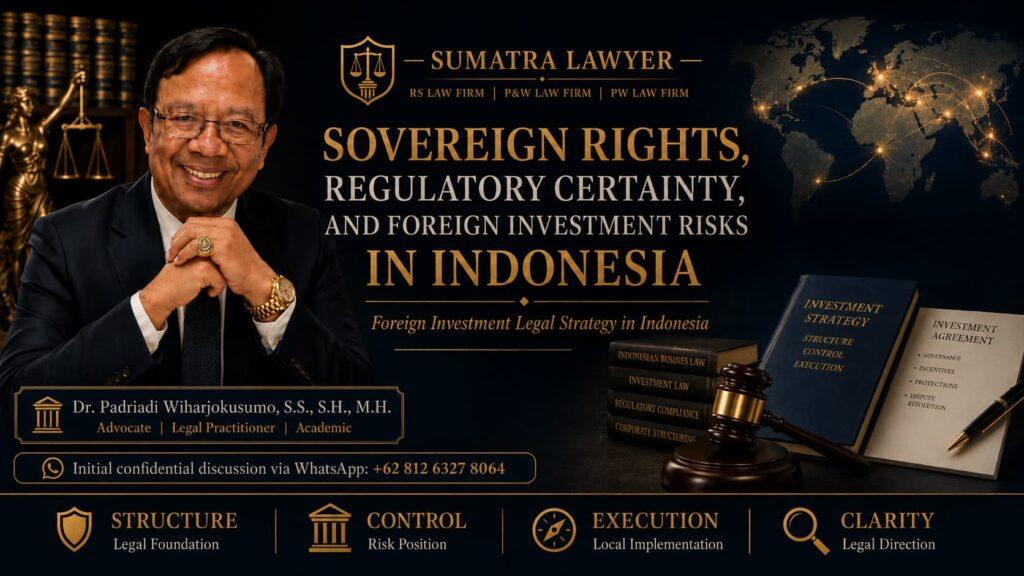
Foreign Investment Risks in Indonesia are no longer limited to licensing, market entry, or corporate documentation. For foreign investors operating in mining, natural resources, infrastructure, downstream processing, and export-oriented sectors, the real question is whether the investment structure can survive regulatory pressure.
Foreign investment in Indonesia is never merely a matter of capital entry.
It is a matter of structure, control, and execution.
This becomes especially important when international investors operate in strategic sectors such as mining, natural resources, infrastructure, downstream processing, and export-oriented industries. In these sectors, the legal environment is not static. Regulations may shift, enforcement priorities may change, and administrative practice may evolve faster than investors expect.
Recent concerns raised by Chinese business stakeholders regarding Indonesia’s nickel sector have placed this issue under sharper international attention. Reuters reported that Chinese companies operating in Indonesia warned that tighter nickel ore quotas, higher taxes, and pricing changes could affect investment conditions in the world’s largest nickel-producing country. The concerns were reportedly communicated through the China Chamber of Commerce in Indonesia to President Prabowo Subianto.
For foreign investors, this development should not be read only as a sectoral dispute. It reflects a deeper legal and institutional tension: the tension between Indonesia’s sovereign right to regulate its natural resources and the investor’s need for regulatory certainty.
This article analyzes that tension through the Padriadi Dialectical Method: thesis, antithesis, and synthesis.
1. Thesis: Indonesia’s Sovereign Right to Regulate
From the perspective of public law and administrative governance, Indonesia has the sovereign right to regulate its territory, natural resources, fiscal policy, and strategic industries.
This is the thesis.
No foreign investor can reasonably expect a host state to freeze its legal system permanently at the time of market entry. Indonesia, like other resource-rich states, has the authority to adjust its regulatory framework in order to protect national interests, increase state revenue, strengthen domestic processing, and ensure that natural resource exploitation contributes to national development.
This sovereign authority may appear in various forms.
First, the government may adjust mining approvals and production planning through the Rencana Kerja dan Anggaran Biaya (RKAB) mechanism. In the mining sector, RKAB is not simply an administrative document. It functions as a key regulatory instrument affecting production planning, operational continuity, and supply chain commitments.
Second, the government may revise fiscal rules, including royalties, taxes, and non-tax state revenue policies. For resource-rich countries, such policies are often justified as a means of ensuring that the state receives a fairer share of economic rent.
Third, Indonesia may regulate Devisa Hasil Ekspor Sumber Daya Alam (DHE SDA). Under Government Regulation No. 8 of 2025, exporters in certain natural resource sectors are required to retain 100% of foreign exchange export proceeds in Indonesia’s financial system for a minimum period of 12 months, subject to certain permitted uses such as tax payments, non-tax revenue, dividends, procurement, and loan repayments.
From the state’s perspective, these measures are not necessarily hostile to investors. They may be viewed as instruments of national economic resilience, resource governance, and domestic value creation.
In other words, Indonesia is not merely a market. It is a sovereign legal order.
2. Antithesis: The Investor’s Need for Regulatory Certainty
The antithesis comes from the investor’s side.
Foreign investors do not invest billions of dollars into smelters, ports, logistics chains, energy infrastructure, and long-term industrial facilities based on short-term assumptions. Their investment models depend on predictability.
They need to understand whether their supply chain will remain viable, whether their export proceeds can support working capital, whether tax exposure can be calculated, and whether operational approvals will be administered with procedural fairness.
When regulatory changes occur too abruptly, the issue is not merely legal compliance. The issue becomes structural risk.
A sudden reduction in approved production capacity may affect supply contracts. A new pricing formula may change commercial margins. Export proceeds retention rules may affect liquidity planning. Retroactive enforcement or unclear administrative interpretation may create uncertainty in corporate decision-making.
For international investors, the central question is therefore not only:
What does the regulation say?
The deeper question is :
Can the investment structure survive regulatory change?
This distinction is crucial.
Many foreign investors enter Indonesia by focusing mainly on licensing, incorporation, and transactional documents. But in practice, legal risk in Indonesia is often shaped by the interaction between national regulation, local administration, sectoral enforcement, land exposure, environmental compliance, and political-economic priorities.
This is particularly relevant in Sumatra and other resource-rich regions, where legal execution is often influenced by regional institutional behavior, land history, overlapping permits, community dynamics, and administrative interpretation on the ground.
That is why foreign investment legal strategy in Indonesia must go beyond document preparation.
It must become a system of structural defense.
3. Synthesis: Aligning Sovereign Compliance with Investor Protection
The synthesis is not to deny Indonesia’s sovereign authority.
The synthesis is also not to tell foreign investors to simply absorb every regulatory shock.
The synthesis is to build a legal architecture that aligns sovereign compliance with investor protection.
For the Indonesian state, regulatory authority becomes stronger when it is exercised with transparency, proportionality, and procedural fairness. Policy changes in strategic sectors may be legitimate, but legitimacy is strengthened when investors are given clear guidance, transition periods, and consultative channels.
For foreign investors, the lesson is equally clear: do not build an Indonesian investment structure based only on optimism, political comfort, or standard incorporation documents.
A serious foreign investment structure should include at least three layers of legal protection.
First, investors should conduct independent compliance audits before problems arise. This includes reviewing RKAB-related exposure, environmental permits, land status, forestry-zone risk, tax compliance, DHE obligations, and sector-specific licensing requirements. Waiting until a government audit begins may place the company in a defensive and less favorable position.
Second, investors should design structural ring-fencing. A localized regulatory dispute should not automatically contaminate the parent company, financing structure, group liquidity, or unrelated assets. This requires careful planning of ownership, contracts, financing, governance, and operational control.
Third, investors must develop local context mastery. National regulations may look clear in Jakarta, but their execution in Medan, Sumatra, and other regions may depend on administrative practice, institutional relationships, land documentation, and enforcement culture. A foreign investor who understands only the statute but not the terrain is exposed.
This is where legal advisory must move beyond formal compliance.
It must help investors understand where legal risk actually lives.
4. The Sumatra Lawyer Perspective
As a lawyer and academic based in Sumatra, I view foreign investment risk in Indonesia through both doctrinal and practical lenses.
In the classroom, the issue may be explained as a conflict between state sovereignty and investor protection.
In legal practice, the same issue appears in a more concrete form: delayed approvals, unclear administrative responses, conflicting documents, land exposure, licensing gaps, tax pressure, enforcement escalation, and difficulty translating corporate expectations into local execution.
This is why the role of a lawyer in Sumatra is not only to read regulations but also to interpret them.
The role is to interpret how regulations operate under pressure.
For investors entering Indonesia, especially in sectors involving natural resources, infrastructure, plantations, energy, logistics, and industrial development, a legal strategy must be built before the dispute begins.
A strong legal structure should answer several questions from the beginning:
Can the company defend its licensing position?
Can the ownership structure withstand scrutiny?
Can the investment survive regulatory adjustment?
Can local execution match the legal assumptions used in the boardroom?
Can the investor protect capital without disrespecting Indonesia’s sovereign authority?
These are not theoretical questions. They are boardroom questions. They are financing questions. They are dispute-prevention questions.
Conclusion: Foreign Investment Requires Legal Architecture
Indonesia remains one of the most important investment destinations in Southeast Asia. Its natural resources, demographic strength, infrastructure development, and downstream industrial strategy continue to attract global capital.
But opportunity in Indonesia must be approached with discipline.
Foreign investors should not see regulation as a mere obstacle. They should see regulation as part of the investment terrain. At the same time, policymakers should understand that regulatory certainty is not a concession to foreign capital. It is a foundation for long-term investment confidence.
The future of foreign investment in Indonesia will not be secured by documents alone.
It will be secured by legal architecture.
For further analysis on cross-border investment, regulatory risk, and corporate legal strategy in Indonesia, readers may explore Padriadi Wiharjokusumo Insights and the broader legal advisory perspective developed through PW Law Firm Medan.
For foreign investors requiring a structured legal assessment before entering or expanding in Indonesia, a formal advisory session may be arranged through the Global Advisory and Consultation Suite.
About the Author
Dr. Padriadi Wiharjokusumo is an Indonesian legal practitioner and academic based in Medan, North Sumatra. His work focuses on cross-border investment, corporate legal strategy, regulatory risk, dispute prevention, and foreign investment structuring in Indonesia. Through his academic and professional practice, he develops a structural approach to legal advisory based on three core elements: structure, control, and execution.
Academic Disclaimer
This article is written for general academic and analytical purposes. It does not constitute legal advice and does not intend to accuse, judge, or represent any specific party, institution, company, or ongoing matter. Foreign investors should seek formal legal advice based on their specific documents, sector, jurisdiction, and factual circumstances before making legal or commercial decisions in Indonesia.
Facing Regulatory Uncertainty in Indonesia?
If your company is facing uncertainty related to RKAB, export proceeds, licensing, taxation, land exposure, or regulatory enforcement in Indonesia, do not wait until the issue escalates into a formal dispute.
Send a brief summary of your situation via WhatsApp for an initial legal assessment:
WhatsApp: +62 812 6327 8064
Please include your company background, sector, location, key issue, available documents, and urgency level.