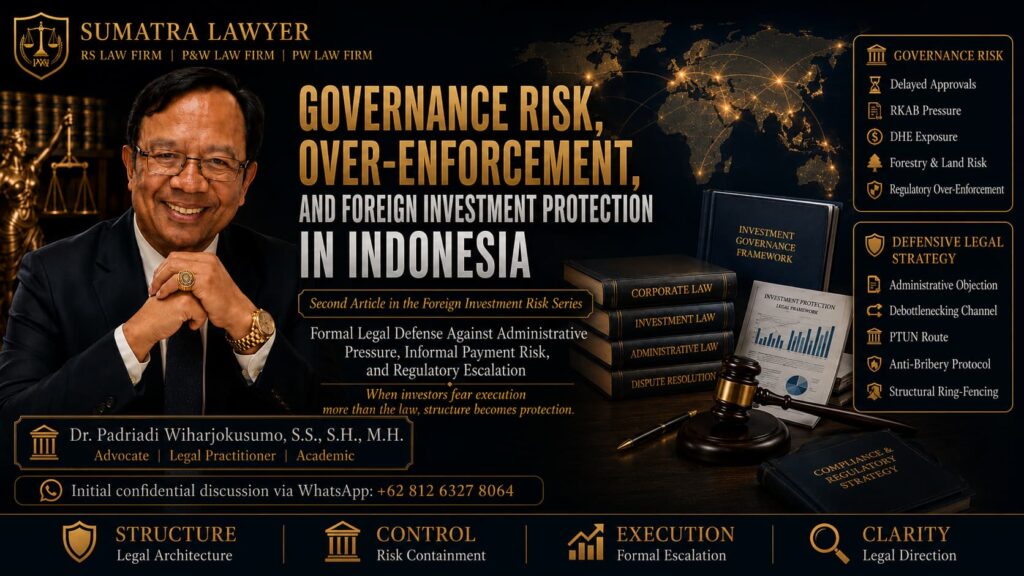
Foreign Investment Protection in Indonesia is no longer only about company registration, licensing, or standard corporate documents. It is about whether a foreign investor can defend its legal position when governance risk, regulatory over-enforcement, administrative pressure, and informal payment exposure begin to affect business operations
Foreign investors rarely fear the law when the law is clear.
This article is the second part of our analytical series on foreign investment risks in Indonesia. The first article examined the tension between Indonesia’s sovereign rights and the investor’s need for regulatory certainty. This second article moves further into the practical field: governance risk, regulatory over-enforcement, alleged informal payment pressure, and the legal defense architecture required to protect foreign investment in Indonesia.
What they fear is uncertainty in execution.
This is the deeper warning behind recent concerns reportedly raised by Chinese companies operating in Indonesia. According to Reuters, the China Chamber of Commerce in Indonesia sent a letter to President Prabowo Subianto warning that tighter nickel ore quotas, higher taxes, a revised pricing formula, foreign exchange retention rules, stricter forestry enforcement, work-visa restrictions, project suspensions, and alleged corruption or extortion by authorities could threaten investment confidence in Indonesia’s nickel sector.
This issue should not be read only as a Chinese investor complaint.
It should be read as a governance risk signal.
For foreign investors, the question is no longer simply whether Indonesia has attractive natural resources, strong downstream potential, and large industrial opportunities. The more urgent question is whether the legal and administrative environment can provide predictable execution when regulatory pressure increases.
This is where Foreign Investment Protection in Indonesia must move beyond corporate registration, licensing assistance, and standard transactional documents.
1. When Regulation Becomes Governance Risk
Indonesia has the sovereign right to regulate its natural resources, mining production, fiscal policy, export proceeds, environmental compliance, and strategic industries.
That right is legitimate.
A sovereign state is not required to freeze its regulatory system for the convenience of foreign capital. Indonesia may revise production quotas, tax policy, forestry enforcement, domestic value-added requirements, and export proceeds regulations in pursuit of national economic priorities.
However, from the investor’s perspective, regulation becomes dangerous when enforcement appears abrupt, inconsistent, unclear, or disproportionate.
In practice, governance risk may arise in several forms.
A company may face delays in approvals. A mining company may face uncertainty in its RKAB. An exporter may face liquidity pressure due to foreign exchange retention rules. A plantation, mining, or infrastructure company may face land or forestry enforcement exposure. A foreign investor may be forced to operate in a gap between what the written regulation says and how the rule is applied in the field.
Government Regulation No. 8 of 2025 changed the framework for Devisa Hasil Ekspor Sumber Daya Alam by regulating the percentage and retention period of export proceeds that must remain in Indonesia’s financial system. Several legal updates explain that exporters in mining, plantation, forestry, and fisheries sectors may be required to retain 100% of DHE SDA for 12 months, subject to sectoral distinctions and permitted uses.
For policymakers, this may be a macroeconomic measure.
For corporate boards, it is a liquidity and risk-control issue.
The gap between these two perspectives is where disputes begin.
2. The Hidden Danger: Informal Pressure and Anti-Bribery Exposure
The most dangerous risk for foreign investors is not always a formal regulation.
Sometimes the greater danger is informal pressure.
When permits are delayed, approvals are unclear, inspections escalate, or administrative communication becomes unpredictable, companies may feel pushed toward intermediaries, “facilitators,” or unofficial channels.
This is where legal exposure becomes global.
A foreign company operating in Indonesia may not only face Indonesian administrative law. It may also face anti-bribery rules in its home jurisdiction, shareholder scrutiny, bank compliance review, sanctions from business partners, and reputational damage in global markets.
This is why the answer to governance friction cannot be informal payment.
It must be a formal legal defense.
Companies must avoid creating evidence that can later be used against them. Any response to bureaucratic pressure should be documented, structured, and legally controlled.
For a foreign investor, the wrong WhatsApp message, the wrong intermediary, the wrong undocumented payment, or the wrong internal instruction can become more dangerous than the original administrative problem.
This is why Foreign Investment Protection in Indonesia requires legal discipline before crisis management begins.
3. Do Not React Informally: Build a Legal Record
When a company faces administrative pressure, the first response should not be panic.
The first response should be legal documentation.
A proper defensive strategy should begin with a written chronology, identification of the relevant permits, review of all correspondence, mapping of the decision-making authority, and classification of whether the problem is regulatory, administrative, fiscal, land-related, environmental, criminal, or political-economic.
This is crucial because different problems require different routes.
If the issue involves an administrative decision, the company may need to prepare a formal administrative objection.
If the issue involves abuse of authority, the matter may require escalation through administrative law mechanisms.
If the issue involves a concrete state administrative decision, the company may need to consider proceedings before the Administrative Court.
If the issue involves alleged informal payment pressure, the company should strengthen its anti-bribery protocol and preserve evidence.
If the issue involves land, forestry, or spatial planning, the company must carefully review whether the exposure is historical, documentary, operational, or enforcement-driven.
The principle is simple:
Do not fight chaos with chaos.
Fight administrative pressure with a legal structure.
4. Debottlenecking as a Formal Channel
One important development is the emergence of formal government channels to address investment bottlenecks.
The Indonesian government has established the Satuan Tugas Percepatan Program Pemerintah untuk Mendukung Peningkatan Pertumbuhan Ekonomi under Presidential Decree No. 4 of 2026. The State Secretariat explains that the task force is responsible to the President and is designed to coordinate and accelerate government programs supporting economic growth.
The Ministry of Finance has also emphasized the use of a debottlenecking channel to support a more conducive investment climate, including practical efforts to resolve investment obstacles. The Ministry of Foreign Affairs has similarly described the debottlenecking channel as part of the government’s effort to strengthen investment acceleration.
For investors, this matters.
It means that companies facing administrative obstruction should not assume that the only options are silence, informal payment, or immediate litigation.
There may be a formal escalation route.
But this route must be used properly.
A company should not enter a debottlenecking process with weak documents, unclear chronology, incomplete licensing history, or emotional allegations. It must enter with a structured legal file.
The stronger the file, the stronger the escalation.
5. Structural Ring-Fencing: Protect the Group Before the Crisis Spreads
Foreign investors often underestimate how quickly a local problem can contaminate a global structure.
A dispute in one local operating company can affect financing, bank confidence, supply contracts, parent-company reporting, investor relations, and regional expansion plans.
This is why structural ring-fencing matters.
A well-designed investment structure should separate operational risk, asset ownership, financing exposure, management authority, contractual obligations, and dispute response mechanisms.
If one project faces regulatory pressure, the whole group should not automatically collapse into the same risk pool.
This is not about avoiding Indonesian law.
It is about respecting Indonesian law while protecting the wider corporate structure from unnecessary contagion.
A proper structure should answer practical questions:
Who controls the asset?
Who signs regulatory correspondence?
Who communicates with local authorities?
Who manages documents?
Who approves payments?
Who handles inspections?
Who reports to the board?
Who preserves evidence?
Who decides whether to negotiate, object, escalate, or litigate?
Without clear answers, the company may look compliant on paper but remain vulnerable in execution.
6. The Sumatra Lawyer Perspective
As a lawyer and academic based in Sumatra, I see this issue not only as a national investment debate, but also as a practical legal reality.
In resource-rich regions, legal risk is often shaped by more than statutes.
It may be shaped by land history, local bureaucracy, informal networks, licensing culture, regional enforcement behavior, community relations, administrative interpretation, and the gap between Jakarta-level policy and field-level execution.
This is why a foreign investor operating in Indonesia needs more than a translator of regulations.
It needs a legal strategist who understands structure, control, and execution.
The role of legal counsel is not merely to read the regulation.
The role is to anticipate how the regulation behaves under pressure.
That is the foundation of Foreign Investment Protection in Indonesia.
Conclusion: Protect the Investment Before the Dispute Begins
The recent concerns raised by foreign business stakeholders should not be dismissed as ordinary complaints.
They reveal a larger structural issue: investment confidence is not built by opportunity alone. It is built by predictable governance, fair procedure, disciplined enforcement, and defensible legal structure.
Indonesia remains a major investment destination.
But investors must understand the terrain.
In Indonesia, the legal question is not only:
“What does the regulation say?”
The stronger question is:
“Can our structure survive when the regulation is enforced?”
For further analysis on cross-border investment, regulatory risk, and corporate legal strategy in Indonesia, readers may explore Padriadi Wiharjokusumo Insights and the broader advisory perspective developed through PW Law Firm Medan.
Facing Governance or Regulatory Pressure in Indonesia?
If your company is facing uncertainty involving delayed approvals, RKAB, DHE, licensing, taxation, forestry enforcement, land exposure, alleged informal payment pressure, or regulatory over-enforcement, do not respond informally.
Build a formal legal record first.
Send a brief summary for an initial confidential discussion via WhatsApp:
WhatsApp: +62 812 6327 8064
Please include your company background, sector, location, issue chronology, relevant documents, and urgency level.
About the Author
Dr. Padriadi Wiharjokusumo is an Indonesian legal practitioner and academic based in Medan, North Sumatra. His work focuses on cross-border investment, corporate legal strategy, foreign investment structuring, regulatory risk, dispute prevention, and governance-related legal exposure in Indonesia. His advisory approach is built around three core elements: structure, control, and execution.
Academic Disclaimer
This article is written for general academic and analytical purposes. It does not constitute legal advice and does not intend to accuse, judge, or represent any specific party, institution, company, official, or ongoing matter. Any company facing regulatory, administrative, fiscal, land, forestry, or enforcement issues in Indonesia should seek formal legal advice based on its specific documents, jurisdiction, sector, and factual circumstances.