
EUDR Traceability Indonesia is no longer only an environmental compliance issue. It is becoming a legal test of HGU data, land sovereignty, supply-chain verification, and foreign investment resilience in Indonesia.
Part II of a Three-Part Series on EUDR, Commodity Governance, and Foreign Investment Resilience in Indonesia
The first article in this series examined the European Union Deforestation Regulation, or EUDR, as more than an environmental regulation. It argued that EUDR represents a form of transnational market governance, where market access is increasingly conditioned on traceability, due diligence, environmental proof, and supply-chain verification.
This second article moves into a more difficult legal terrain.
If Part I asked whether EUDR may reshape Indonesia’s commodity access to the European market, Part II asks a deeper question:
What happens when EUDR’s traceability standards collide with Indonesia’s sovereign land law system?
The issue is not merely whether palm oil, rubber, coffee, cocoa, or other land-based commodities are deforestation-free. The deeper issue is whether foreign market-access rules can require land-level digital proof in a way that intersects with Indonesia’s authority over land administration, HGU data, spatial planning, plantation governance, smallholder tenure, and sovereign control over land-related information.
This is the legal friction at the center of EUDR implementation in Indonesia.
EUDR is forcing a new reality: market access is becoming dependent on land data.
For Indonesia, especially for commodity-producing regions such as Sumatra, this is not only a compliance issue. It is a sovereignty issue, a land governance issue, and a foreign investment risk issue.
From Market Access to Land-Level Verification
EUDR is often discussed in the language of environmental responsibility. That framing is correct, but incomplete.
At the regulatory level, EUDR aims to ensure that relevant commodities and products placed on, made available in, or exported from the European Union are not associated with deforestation or forest degradation. The European Commission describes its implementation framework as one involving due diligence, operator obligations, and an information system for electronic due diligence statements.
But at the legal-structural level, EUDR does something more powerful.
It shifts the burden from general environmental representation to land-level verification.
In older compliance models, a company could often rely on certificates, commercial documents, supplier declarations, shipment records, and internal sustainability statements. Under EUDR, the direction is more specific. The company must be able to connect the commodity to the land from which it originated and demonstrate that the commodity meets deforestation-free and legality requirements under the applicable framework.
This changes the nature of legal risk.
The questions are no longer only:
Is the company licensed?
Is the supplier registered?
Is the commodity commercially available?
The new questions are:
Where was the commodity produced?
Can the land be identified?
Can the coordinates be verified?
Can the plot be connected to the commodity?
Can the company demonstrate legality under the laws of the producing country?
Can the supply chain defend its documentation if challenged by buyers, regulators, banks, or customs authorities?
This is where Indonesia’s land law system becomes central.
For commodities such as palm oil, rubber, coffee, cocoa, and other land-based products, traceability is not simply a supply-chain function. It touches land rights, plantation licensing, concession boundaries, spatial planning, HGU documentation, smallholder records, customary claims, administrative maps, and the legal control of land-related data.
In Sumatra, this issue is especially significant because commodity production is deeply connected to land structures, plantation areas, smallholder networks, processing facilities, logistics routes, export ports, and foreign investment exposure.
EUDR Traceability Indonesia and the New Burden of Proof
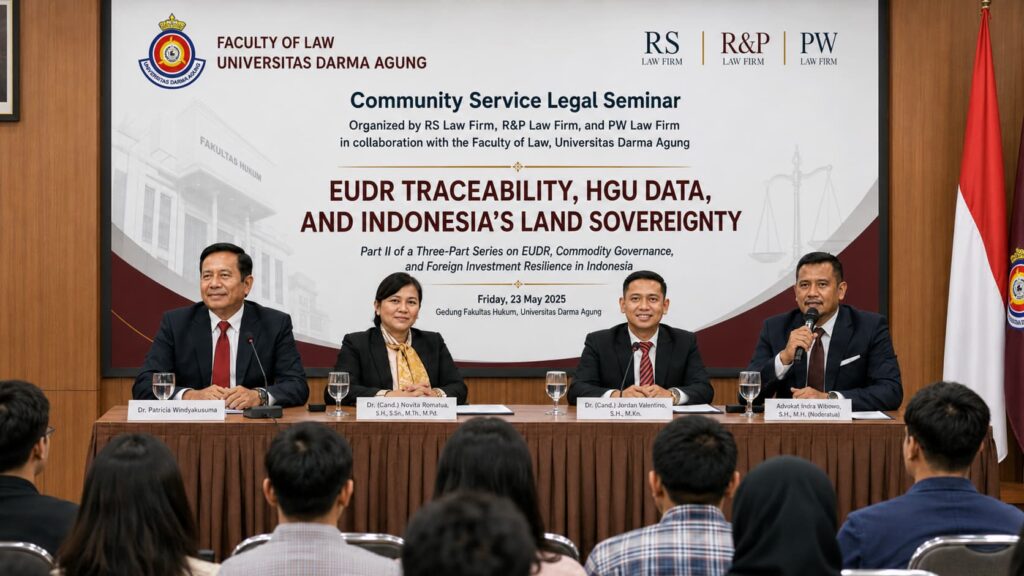
Community Service Legal Seminar on EUDR traceability, HGU data, and Indonesia’s land sovereignty, organized by RS Law Firm, R&P Law Firm, and PW Law Firm in collaboration with the Faculty of Law, Universitas Darma Agung, featuring Dr. Padriadi Wiharjokusumo, Dr. (Cand.) Novita Romauli, Dr. (Cand.) Jordan Valentino and Advokat Indra Wibowo as moderator.
The thesis of traceability appears simple: if a commodity is truly deforestation-free, its origin should be traceable.
As a principle, this is difficult to reject.
Environmental responsibility requires proof. Global buyers increasingly demand transparency. Financial institutions are becoming more sensitive to environmental, social, and governance risks. Consumers and regulators want assurance that commodities are not linked to deforestation, illegal land clearing, or weak supply-chain governance.
But the antithesis is equally important.
Traceability is not neutral when it requires land-level data from countries whose land administration systems have their own legal limits, historical complexities, administrative gaps, and sovereignty concerns.
EUDR’s geolocation requirement changes compliance from paper-based documentation into spatial proof. The legal expectation moves from “show us your documents” to “show us precisely where this commodity came from.”
That is a major shift.
The official EU legal framework requires due diligence information to include geolocation data for relevant plots of land, depending on the commodity and production structure.
For large integrated plantation groups, this may be difficult but potentially manageable. They may have concession maps, internal plantation records, GIS systems, supplier controls, and stronger compliance departments.
For mixed supply chains, the challenge is much greater.
A processor may buy from dealers, cooperatives, agents, plasma farmers, independent smallholders, or third-party suppliers. A trader may not always have direct access to the original production plot. A mill may process commodities from multiple upstream sources. A plantation company may have strong records for its own concession but weaker visibility over independent external suppliers.
This is where legal risk begins.
A commodity may be physically available, commercially valuable, and domestically marketable. But if its origin cannot be legally verified in the required format, it may become vulnerable in export markets.
In other words, production capacity is no longer enough.
Traceability capacity is becoming part of investment value.
HGU Data and Indonesia’s Sovereign Land Administration
Hak Guna Usaha, or HGU, is not merely a business document.
It is part of Indonesia’s land administration system. It reflects state authority over land allocation, plantation use, concession boundaries, business licensing, land governance, and long-term investment structures.
For plantation companies, HGU is central to legal certainty.
For the state, HGU data is part of a broader framework of land control, spatial administration, economic planning, and national governance.
This is where EUDR creates legal friction.
On one side, European market-access rules demand increasing transparency, traceability, and geolocation proof. On the other side, Indonesia has a sovereign interest in controlling the disclosure, validation, use, and circulation of land-related data.
HGU boundaries, plantation maps, spatial information, concession overlaps, and related land documents are not merely technical files. They may involve economic security, investment protection, local disputes, administrative authority, overlapping claims, land conflict, and public-order concerns.
The legal question is therefore not simply whether data exists.
The deeper question is:
Who has the authority to control, validate, disclose, and transmit land-related data for cross-border compliance purposes?
This is the core problem.
If a company discloses land-related information too broadly, it may create domestic legal, administrative, commercial, or conflict-related exposure. But if it fails to provide sufficient geolocation information, it may face rejection, delay, enhanced scrutiny, or market-access disruption in the European market.
The company may therefore be exposed in both directions.
It may be exposed to European market-access risk if traceability is incomplete.
It may also be exposed to domestic legal or administrative risk if land-related data is disclosed, interpreted, or used without proper legal control.
This is why EUDR compliance cannot be treated merely as an environmental checklist.
It must be examined as a legal architecture problem.
The Legal Friction: EUDR Compliance vs Indonesian Land Law Realities
The central friction can be stated simply:
EUDR requires traceability that may depend on land-level disclosure, while Indonesia’s land governance system contains legal, administrative, and institutional concerns over how land data is controlled, accessed, and relied upon.
This friction produces difficult legal questions.
Can a plantation company disclose geolocation or polygon-related data without exposing sensitive land information?
Can an exporter rely on supplier-provided coordinates if those coordinates have not been legally verified?
Can a buyer reject a shipment because smallholder plots cannot be mapped with sufficient precision?
Can a commodity trader be held responsible for upstream land documentation gaps beyond its direct control?
Can a foreign investor properly value an asset if HGU records, supplier land tenure, spatial planning, and traceability systems are not aligned?
Can domestic legal compliance still be commercially insufficient if it does not satisfy external market-access verification?
These are not theoretical questions.
They affect contracts, financing, export readiness, supply-chain audits, liability allocation, investment valuation, and corporate governance.
This is the dialectical tension:
The thesis says that traceability is necessary for environmental accountability.
The antithesis says that traceability cannot be imposed in a way that ignores domestic land sovereignty and real land-tenure complexity.
The synthesis must therefore be more sophisticated:
Indonesia does not need to reject traceability. But traceability must be structured through legally controlled, sovereign, and institutionally credible systems.
Smallholders in the Blind Spot: Informal Land Tenure and Exclusion Risk
One of the most difficult dimensions of EUDR implementation is the position of smallholders.
In Sumatra, many commodity supply chains depend on independent farmers and small-scale producers. Some may hold formal land certificates. Others may rely on village letters, local statements, inheritance arrangements, customary recognition, cultivation history, informal documents, or community-based acknowledgment.
From a local social perspective, a farmer may be recognized as cultivating a particular plot.
From a commercial perspective, that farmer may have supplied a commodity chain for years.
But from a strict traceability perspective, the same farmer may not be able to produce the type of formal land documentation, geolocation proof, or polygon mapping expected by international buyers.
This is not only a documentation problem.
It is a development problem.
The FAO Voluntary Guidelines on the Responsible Governance of Tenure emphasize secure tenure rights and equitable access to land, fisheries, and forests, including public, private, communal, indigenous, customary, and informal forms of tenure.
That perspective is highly relevant for Indonesia.
If EUDR implementation does not adequately account for smallholder realities, the result may be exclusion. Farmers who cannot provide digital land proof may be pushed out of export-oriented supply chains, even if they have long participated in the commodity economy.
This would create a paradox.
A regulation designed to promote environmental responsibility could unintentionally produce social and economic vulnerability if smallholders are excluded because they lack formal documentation or technical mapping capacity.
For Sumatra, this risk is serious.
Commodity supply chains are not only corporate systems. They are rural economic systems. They connect farmers, local buyers, mills, exporters, logistics providers, financing arrangements, port access, and international markets.
If smallholders become legally invisible in traceability systems, the social cost may be significant.
ISPO, EUDR, and the Problem of Mutual Recognition
Indonesia has not been passive in sustainability governance.
The Indonesian Sustainable Palm Oil system, or ISPO, reflects Indonesia’s domestic approach to plantation sustainability, legality, and governance. The legal question is whether domestic certification and national compliance systems will receive adequate recognition within external market-access regimes such as EUDR.
This is where mutual recognition becomes central.
If EUDR operates without sufficient regard for Indonesia’s domestic certification, land administration, and plantation governance systems, then domestic legal compliance may not be enough to secure international market access.
A company may comply with Indonesian law and still face European market-access problems if its documentation does not match EUDR verification expectations.
That gap is the heart of the problem.
The issue is not simply whether Europe has the right to regulate its market. It does.
The deeper question is whether the interface between European market regulation and Indonesian legal sovereignty is fair, workable, and institutionally respectful.
A fair system must create interoperability between European due diligence expectations and Indonesian legal institutions. It must recognize the role of domestic certification, state-validated data, national dashboards, land administration systems, and smallholder inclusion mechanisms.
The goal should not be regulatory confrontation.
The stronger goal is structured recognition:
credible environmental accountability combined with respect for sovereign land governance.
Why This Matters for Sumatra’s Commodity Investment Structure
For Sumatra, the issue is not abstract.
Sumatra is one of Indonesia’s most important commodity regions. Plantation assets, smallholder networks, mills, ports, logistics routes, and foreign investment structures are deeply connected. Palm oil, rubber, coffee, cocoa, and other commodities are not merely products. They are legal and commercial systems.
This point connects directly to the first article in this series, which emphasized that commodity supply chains in Sumatra involve plantation licenses, HGU, supplier contracts, smallholder relationships, financing arrangements, export documentation, and local administrative records.
That is why the EUDR risk must be evaluated at the structural level.
A plantation asset may be productive, but if its supply chain cannot support traceability, the asset may lose export value.
A mill may operate efficiently, but if its third-party suppliers cannot be mapped, its market access may be vulnerable.
A trader may secure volume, but if the origin documentation is weak, the transaction may face legal and commercial risk.
A foreign investor may acquire an apparently profitable commodity asset but later discover that its export value depends on data systems, supplier controls, land verification, and compliance architecture that were never properly built.
This is where EUDR becomes a foreign investment issue.
The investor is no longer investing only in land, production, logistics, or export opportunities.
The investor is investing in the legal defensibility of the supply chain.
Strategic Legal Response: State-Led Traceability and Corporate Legal Structuring
Indonesia should not respond to EUDR by rejecting traceability.
Traceability is becoming part of global commodity governance. The stronger legal position is not resistance to transparency, but structured transparency under sovereign legal control.
This means Indonesia needs a state-led traceability framework capable of protecting national land data while supporting credible export compliance.
Such a framework should be able to connect commodity origin, legal land status, certification, smallholder inclusion, and export documentation without surrendering uncontrolled access to sensitive land data.
For companies, the legal response must also be practical.
First, supplier contracts should be reviewed. Traceability obligations, documentation duties, data warranties, audit rights, indemnity clauses, and liability allocation must be clearly structured.
Second, land documentation should be stress-tested. HGU records, operational maps, concession boundaries, supplier areas, smallholder sources, and spatial planning references must be examined against real business operations.
Third, corporate governance must include supply-chain data control. EUDR compliance is not only a sustainability department issue. It affects legal, compliance, procurement, finance, export, and board-level risk.
Fourth, investors should conduct EUDR-sensitive legal due diligence before acquiring, financing, or expanding commodity assets. A profitable asset may become exposed if its supply chain cannot satisfy market-access proof.
Fifth, smallholder inclusion must be built into compliance systems. Exclusion may reduce short-term documentation risk, but it can create social conflict, supply instability, reputational exposure, and long-term commercial weakness.
The future of commodity investment will depend not only on production strength.
It will depend on the traceability architecture.
Conclusion: Traceability Without Sovereignty Is Legally Incomplete
EUDR has changed the legal landscape for Indonesia’s commodity sector.
It connects environmental compliance, land documentation, digital traceability, export readiness, and investment resilience. It also reveals a deeper legal tension between external market-access rules and domestic land sovereignty.
Indonesia should not ignore environmental responsibility.
But environmental responsibility cannot be built by bypassing national land law, smallholder realities, or sovereign control over land-related data.
The synthesis is clear:
Traceability without sovereignty is legally incomplete.
For Sumatra, this issue is urgent. Commodity supply chains must now be viewed as legal structures. HGU, supplier contracts, smallholder relationships, spatial planning, certification, export documentation, and data governance are no longer separate matters. They are parts of one investment-risk system.
The third article in this series will examine how corporations, exporters, and foreign investors operating in Indonesia’s commodity sectors should restructure contracts, audit supply chains, allocate liability, and prepare compliance defense before EUDR-related risks become commercial disputes or market-access failures.
Strategic Legal Inquiry
For foreign investors, exporters, plantation companies, commodity traders, and corporate groups exposed to Indonesia’s commodity sector, EUDR traceability should be reviewed not only as a sustainability requirement, but also as a land documentation, data governance, supply-chain integrity, and investment-structure issue.
For strategic legal inquiry concerning foreign investment, commodity investment risk, HGU-related land documentation, supply-chain traceability, and EUDR-related market-access issues in Indonesia, readers may contact:
Dr. Padriadi Wiharjokusumo
International Law Lecturer | Legal Practitioner
Medan, North Sumatra, Indonesia
WhatsApp: +62 812-6327-8064
Email: knb.ministry76@gmail.com
Professional Advisory Platform: PW Law Firm Medan
Legal Insights: padriadiwiharjokusumo.com

About the Author
Dr. Padriadi Wiharjokusumo is a legal practitioner and academic based in Medan, North Sumatra, Indonesia. He teaches International Law and has authored International Law Book 1 and International Law Book 2. His work focuses on international law, foreign investment, corporate strategy, regulatory risk, land-related legal structures, and commodity-sector investment risks in Indonesia.
Academic Disclaimer
This article is intended for academic and strategic legal analysis only. It does not constitute legal advice for any specific transaction, dispute, investment structure, land matter, supply-chain arrangement, or regulatory issue. For practical legal assistance in Indonesia, readers should seek professional legal advice based on the relevant facts and documents.
LAWYERS WHO KNOW SUMATRA
Tags:
EUDR #HGU #LandSovereignty #IndonesiaLaw #ForeignInvestment #CommodityGovernance #LegalSeminar #CommunityService #PengabdianMasyarakat #FacultyOfLaw #UniversitasDarmaAgung #RSLawFirm #RPLawFirm #PWLawFirm #SumatraLaw #IndonesianLegalAdvisory #CorporateLaw #InvestmentResilience #Traceability #DrPadriadiWiharjokusumo