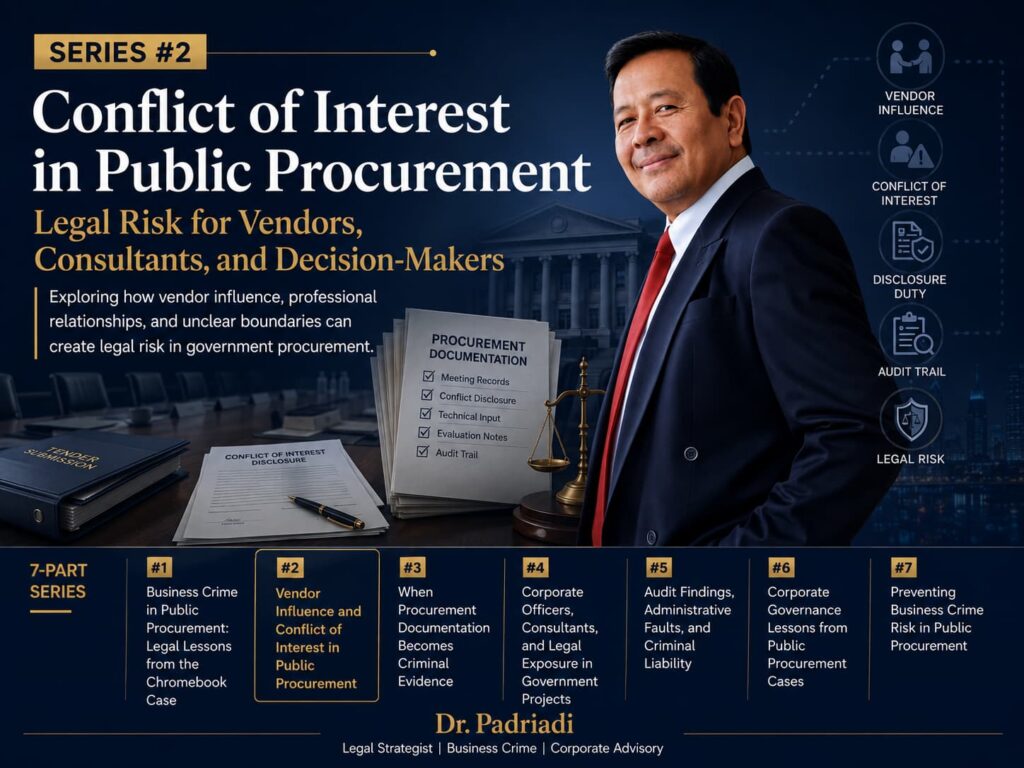
Conflict of Interest in Public Procurement is one of the most sensitive legal risks in government-related projects. It may begin as a normal professional relationship, technical discussion, market consultation, or policy advice. But when the boundary is unclear, it can develop into a serious business crime risk.
This article is part of the Dr. Padriadi series on Business Crime, Public Procurement, and Corporate Legal Risk. It continues the discussion from the first article, Business Crime in Public Procurement: Legal Lessons from the Chromebook Case.
This article does not intend to judge any ongoing case. Its purpose is to explain why conflict of interest must be treated as a legal risk, not merely as an ethical issue.
Table of Contents
- Why Conflict of Interest Matters in Public Procurement
- Thesis: Professional Relations Are Necessary
- Antithesis: Professional Relations Can Create Legal Risk
- Synthesis: Transparency and Documentation as the Legal Middle Path
- Legal Risk for Vendors, Consultants, and Decision-Makers
- Corporate Lessons from Procurement Disputes
- Conclusion
Why Conflict of Interest Matters in Public Procurement
Public procurement involves public money, private vendors, technical specifications, administrative discretion, and public accountability. This combination makes procurement highly vulnerable to legal, corporate, and reputational risk.
In Indonesia, government procurement is regulated under the framework of public procurement regulations. But procurement integrity is not only about formal compliance. It is also about whether the decision-making process is fair, neutral, accountable, and free from improper influence.
A conflict of interest does not always mean corruption has occurred. However, it creates a danger zone. It raises the question whether a public decision was made for public benefit or influenced by personal, commercial, institutional, or relational interests.
For companies, this is where corporate legal risk becomes real.
In this context, Conflict of Interest in Public Procurement must be understood as an early legal warning, especially when public decisions involve vendors, consultants, and technical advisers.
For vendors and consultants, Conflict of Interest in Public Procurement may expose a company not only to reputational damage, but also to contractual, administrative, and criminal allegations.
Thesis: Professional Relations Are Necessary
The first point must be balanced. Public institutions cannot work in isolation. They need information from the market, technical input from vendors, advice from consultants, and cooperation with private companies.
In complex projects, especially technology, infrastructure, healthcare, education, and digital transformation, the government may need technical dialogue before making procurement decisions. This is not automatically wrong.
Vendors may explain their products. Consultants may provide expertise. Decision-makers may compare options. Public institutions may study market availability, user needs, price structure, and international standards.
This is the thesis: professional relations are necessary in public procurement.
Without professional interaction, procurement may become inefficient, outdated, or disconnected from real market capability.
Antithesis: Professional Relations Can Create Legal Risk
The opposite side is also true. Professional relations can become legally dangerous when the boundary is unclear.
Risk may arise when a vendor receives special access, when a consultant influences specifications, when a decision-maker has personal or institutional connections with a supplier, or when communication is not properly documented.
The OECD Principles for Integrity in Public Procurement emphasize good governance across the entire procurement cycle. The World Bank Procurement Guidance on Conflict of Interest is also designed to help identify and manage conflicts of interest in procurement processes. Similarly, the UNODC discussion on corruption in public procurement explains that procurement corruption may arise from conflict of interest situations where public benefits are diverted through improper decision-making.
In plain terms, the problem is not merely whether people know each other. The problem is whether that relationship affects the fairness, neutrality, or accountability of the procurement process.
This is the antithesis: professional relations can create business crime risk.
Synthesis: Transparency and Documentation as the Legal Middle Path
Under the Padriadi Dialectical Method, the legal middle path is not to prohibit all interaction between government and business. That would be unrealistic.
The better solution is transparency, documentation, and governance.
Public procurement must allow professional input, but it must also protect the decision-making process from hidden influence. Every important meeting, recommendation, technical input, market engagement, and specification discussion should be recorded and justifiable.
Conflict of interest should be declared early. Roles should be separated clearly. A consultant should not quietly become a shadow decision-maker. A vendor should not shape the procurement design in a way that limits fair competition. A public official should not participate in a decision where personal, family, institutional, or commercial interests may affect neutrality.
The legal test is not only what happened. It is also whether the process can be explained later before auditors, investigators, courts, shareholders, or the public.
Legal Risk for Vendors, Consultants, and Decision-Makers
For vendors, the risk is reputational, contractual, civil, administrative, and criminal. A company may win a project, but later face allegations that the process was unfairly influenced.
For consultants, the risk is role confusion. A consultant may begin as an adviser but later be seen as a hidden architect of procurement decisions. This can become dangerous if the advice appears to favor a certain vendor, product, system, or commercial ecosystem.
For public decision-makers, the risk is abuse of authority. A decision may be challenged if it appears to be influenced by personal interest, external pressure, or improper private benefit.
This is why procurement-related disputes should be assessed early as part of broader legal strategy and dispute risk management, not only after an investigation begins.
Corporate Lessons from Procurement Disputes
The corporate lesson is simple: do not treat conflict of interest as a minor administrative issue.
Companies involved in government projects should maintain a conflict of interest policy, meeting records, communication logs, pricing justification, internal approval notes, and legal review of tender participation.
They should also train their business development teams. Many legal problems begin not in the legal department, but in informal conversations, early market engagement, WhatsApp messages, presentation meetings, and undocumented technical discussions.
This is why Dr. Padriadi Wiharjokusumo views procurement risk as a hybrid issue: legal, corporate, administrative, ethical, and strategic.
Conclusion
Conflict of interest in public procurement is not always corruption. But it is always a warning sign.
Public institutions need professional input. Vendors and consultants may legitimately support public projects. But when access, influence, specifications, pricing, and decision-making are not transparent, procurement can move from policy into business crime risk.
For companies, vendors, consultants, and decision-makers, the key lesson is clear: legal risk in procurement begins before the contract is signed.
Therefore, Conflict of Interest in Public Procurement should be managed before the tender process, not only after an audit or investigation begins.
Need a legal assessment on procurement or conflict of interest risk?
If your company, institution, or project team is dealing with procurement-related legal risk, conflict of interest concerns, audit findings, vendor-related allegations, or business crime exposure in Indonesia, early legal assessment can help clarify the legal position before the matter develops further.
You may contact Dr. Padriadi Wiharjokusumo through DP or consult PW Law Firm for structured legal assistance in corporate, procurement, business crime, and dispute-related matters.
WhatsApp: +62 812 6327 8064
Email: pwlawfirmmedan@gmail.com
Website: https://pwlawfirmmedan.com/
Disclaimer
This article is for legal education and general information only. It does not constitute legal advice and does not determine the guilt or innocence of any party in any ongoing legal proceeding. Specific legal assessment must be based on facts, documents, applicable law, and professional consultation.
Author
Dr. Padriadi Wiharjokusumo is a lawyer, lecturer, and international legal strategist focusing on corporate legal risk, public procurement, business crime, dispute strategy, and governance-related legal issues in Indonesia.

LAWYERS WHO KNOW SUMATRA
Related Topics:
Conflict of Interest | Public Procurement | Business Crime | Corporate Legal Risk | Procurement Governance | Anti-Corruption | Vendor Risk | Consultant Liability | Indonesia Law | Padriadi Wiharjokusumo