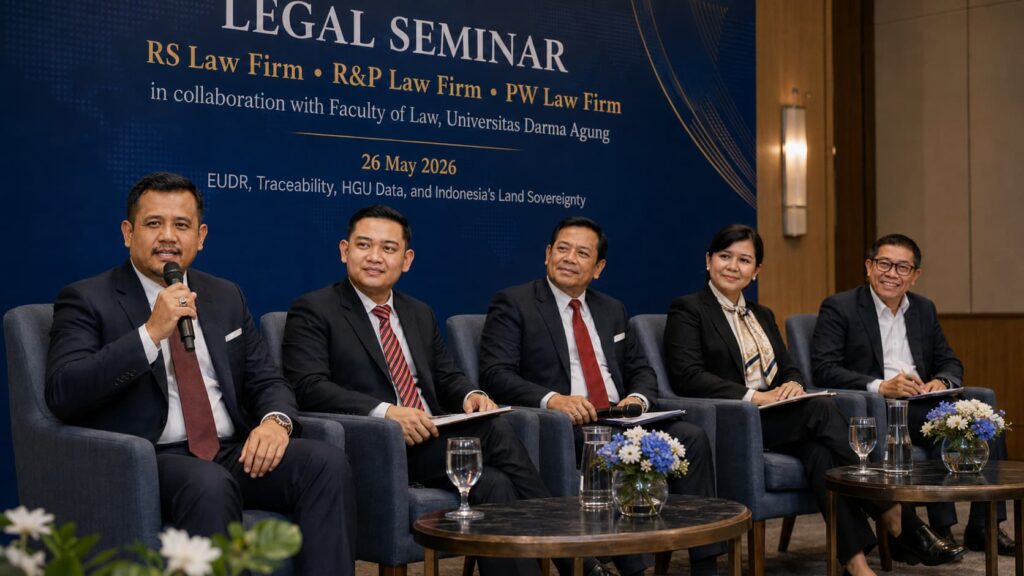
Sovereign traceability Indonesia is now becoming a strategic legal issue under the European Union Deforestation Regulation, or EUDR. For Indonesia, especially Sumatra, traceability is no longer merely about environmental compliance. It now intersects with land-data sovereignty, HGU governance, smallholder inclusion, indigenous communities, and foreign investment resilience.
Part III of a Three-Part Series on EUDR, Commodity Governance, and Foreign Investment Resilience in Indonesia
The first article in this series, EUDR and Indonesia Commodity Investment: Global Trade Law, examined the European Union Deforestation Regulation, or EUDR, as more than an environmental rule. It argued that EUDR reflects a broader transformation in global market governance, where market access is increasingly shaped by traceability, due diligence, legality verification, environmental proof, and supply-chain accountability.
The second article, EUDR Traceability, HGU Data, and Indonesia’s Land Sovereignty, moved deeper into Indonesia’s legal terrain. It argued that EUDR traceability is no longer only a compliance issue. It intersects directly with HGU data, concession boundaries, spatial planning, smallholder tenure, plantation licensing, land administration, and sovereign control over land-related information.
This third article offers a synthesis.
Indonesia should not reject traceability. But Indonesia should also not surrender its land-data sovereignty to external market mechanisms without a clear domestic legal architecture.
The more constructive question is therefore not whether Indonesia should comply or resist.
The more important question is:
How can Indonesia construct a sovereign, inclusive, and credible traceability framework that protects forests, respects land sovereignty, includes smallholders and indigenous communities, and strengthens foreign investment resilience?
This is where the issue moves beyond compliance.
It becomes a question of legal architecture.
The Padriadi Dialectical Method: Thesis, Antithesis, and Synthesis
The legal debate surrounding EUDR must be examined dialectically.
The thesis is clear.
EUDR seeks to ensure that relevant commodities and products placed on, made available in, or exported from the European Union are not linked to deforestation or forest degradation. The European Commission explains EUDR as part of the EU framework for deforestation-free products, involving due diligence obligations, information systems, and traceability requirements for relevant commodities.
This objective cannot be dismissed lightly.
Deforestation is real. Environmental degradation is real. Supply-chain opacity is real. Weak land governance can create serious risks for communities, investors, financial institutions, and producing countries themselves.
From this perspective, EUDR introduces pressure for greater discipline. It pushes companies, exporters, traders, and producing states to improve documentation, supply-chain mapping, legality proof, and environmental accountability.
But the antithesis is equally important.
Traceability is not neutral when it requires land-level data from countries whose land governance systems involve complex histories, overlapping claims, administrative limitations, customary territories, smallholder informality, concession disputes, and sovereign concerns over spatial data.
For Indonesia, especially commodity-producing regions such as Sumatra, land is not merely an economic asset. It is a legal object, a social space, an administrative responsibility, an investment foundation, and sometimes a source of unresolved historical conflict.
This means that EUDR cannot be treated merely as a technical export checklist.
It must be examined as a legal, institutional, and sovereignty challenge.
The synthesis is therefore this:
Indonesia needs a sovereign and inclusive traceability framework.
Sovereign, because land-related data must be validated, controlled, and governed through Indonesia’s legal system.
Inclusive, because traceability that protects forests but excludes smallholders, indigenous communities, and vulnerable producers would create a new form of legal inequality.
Credible, because foreign buyers, regulators, banks, and investors will not rely on political statements alone. They will need verifiable legal assurance.
The Limits of Defensive Sovereignty
Indonesia has legitimate reasons to protect land-related data.
HGU boundaries, concession maps, plantation records, spatial overlays, smallholder data, supply-chain routes, and land-use information are not ordinary commercial files. They may involve public administration, investment protection, economic security, local conflict, overlapping land claims, and broader questions of national governance.
For that reason, Indonesia should be careful before allowing raw land-level data to circulate freely through external private platforms, foreign buyers, or fragmented business-to-business mechanisms.
However, sovereignty cannot become a slogan that avoids reform.
If sovereignty is used only to close access, delay verification, or avoid difficult land-governance questions, it will weaken Indonesia’s position rather than strengthen it.
The global market is moving toward verifiable proof.
Foreign investors are also becoming more sensitive to environmental, social, and governance risks. For companies seeking to invest in plantations, processing facilities, logistics chains, export infrastructure, or downstream commodity industries in Sumatra, legal certainty is no longer limited to permits and corporate documents.
They will ask deeper questions:
Can the commodity be traced?
Can the land origin be verified?
Can the supplier base survive EUDR scrutiny?
Are there unresolved HGU or land-overlap issues?
Are smallholders documented?
Are indigenous or customary claims being ignored?
Can the investment structure survive buyer audits, bank due diligence, and regulatory challenge?
This is why the broader work of PW Law Firm Medan on strategic legal advisory, foreign investment, corporate risk, and Sumatra-based legal execution becomes highly relevant. Commodity investment is no longer only a question of market entry. It is a question of whether the legal structure can survive pressure.
Defensive sovereignty alone is insufficient.
Indonesia needs operational sovereignty.
National Dashboard as a Sovereign Legal Intermediary
A credible solution should begin with a national traceability architecture.
Indonesia should strengthen a National Commodity Dashboard or similar national traceability mechanism as a sovereign legal intermediary.
This dashboard should not be understood merely as a database.
It should function as a legal clearing mechanism.
Under this approach, plantation companies, processors, exporters, cooperatives, suppliers, and smallholder groups submit relevant data into an Indonesian-controlled system. The state then validates key legal elements, including land status, geolocation, legality indicators, supply-chain connections, and risk classification.
The objective is not to hide information.
The objective is to prevent uncontrolled exposure of raw land-related data while still producing credible proof for international market access.
This model may allow Indonesia to move from a purely business-to-business traceability model toward a business-to-government-to-market model.
In such a framework, the state becomes the verifier, not a passive observer.
Indonesia could issue structured compliance evidence, validation reports, or official traceability confirmations that are recognized by buyers, regulators, financial institutions, and trading partners.
This is the legal middle path.
Indonesia should not say, “We refuse traceability.”
Indonesia should say, “Traceability must operate through a sovereign, lawful, auditable, and inclusive national framework.”
Why Sovereign Traceability Must Also Be Inclusive
A sovereign dashboard will fail if it only protects government control and corporate interests.
The credibility of Indonesia’s position depends on whether the system also protects smallholders, indigenous communities, and vulnerable producers.
This is the moral and legal center of the issue.
Many smallholders do not operate with sophisticated GIS systems, digital land records, corporate compliance departments, or professional documentation teams. Some may operate through informal arrangements, inherited cultivation, cooperative networks, plasma schemes, or long-standing local practices that are not always neatly reflected in formal administrative systems.
Indigenous communities face an even deeper challenge.
Their relationship with land may be historical, cultural, spiritual, communal, and customary. Yet their formal recognition within state administration may be incomplete, delayed, contested, or fragmented across institutions.
If EUDR traceability is applied mechanically, these groups may become the first victims.
They may be excluded from export supply chains not because they are destroying forests, but because they cannot produce documentation in the form demanded by global markets.
That would be a serious legal injustice.
A traceability system that protects forests but excludes smallholders would create a new form of market-based discrimination.
Therefore, Indonesia’s sovereign traceability framework must be inclusive by design.
It should include support for smallholder registration, participatory mapping, integration of local data, assistance for STDB processes, cooperative-level documentation, and legal pathways for communities whose land status remains administratively unresolved.
This is not charity.
It is investment protection.
A supply chain that excludes its weakest participants is not resilient. It is fragile.
HGU, Customary Land, and the Credibility of Domestic Legal Governance
The most difficult issue is not the European Union.
The most difficult issue is Indonesia’s own land-governance complexity.
HGU is central to plantation investment. It reflects state authority over land allocation, plantation use, business licensing, concession boundaries, and long-term investment planning. For corporations, HGU is a foundation of legal certainty. For the state, it is part of national land administration.
But in practice, HGU may intersect with other realities: local land claims, customary territories, village boundaries, smallholder cultivation, forest-area classification, spatial planning issues, and historical disputes.
This is why EUDR places pressure on Indonesia’s domestic legal governance.
If Indonesia wants to defend land sovereignty internationally, it must strengthen land justice domestically.
Sovereignty is not only the power to resist external pressure.
Sovereignty is also the capacity to govern fairly, verify accurately, resolve conflicts, and protect the people who live within the territory of the state.
This is where civil society and indigenous community concerns should not be dismissed as opposition to development.
They should be treated as part of the legal risk map.
When civil society raises concerns about deforestation, concession transparency, indigenous territories, or weak land governance, those concerns may be uncomfortable. But they also reveal the kinds of risks that international buyers, banks, regulators, and investors will increasingly examine.
Ignoring these issues does not protect investment.
It merely transfers the risk into the future.
Toward a Just Legal Transition for Smallholders
Indonesia needs a just legal transition.
This means that smallholders and indigenous communities should not be abandoned in the shift from paper-based commodity trade to spatially verified commodity governance.
Several steps are necessary.
First, smallholder documentation must be accelerated. STDB processes, cooperative data, supplier records, and local cultivation information should be made easier, cheaper, and more accessible.
Second, participatory mapping should be integrated into the national traceability architecture. Communities that have long-standing land relationships should not be invisible simply because their documentation is incomplete.
Third, companies benefiting from commodity supply chains should carry legal and operational responsibility to support traceability capacity among their suppliers. This includes plasma farmers, independent smallholders, cooperatives, agents, and third-party suppliers.
Fourth, government agencies should coordinate land, plantation, trade, environment, and investment data. Fragmented authority will create fragmented compliance.
Fifth, Indonesia should negotiate recognition of its national traceability mechanism with the European Union and other trading partners. The purpose is to ensure that domestic legal verification is not ignored by foreign market systems.
This is where international law, trade law, investment law, land law, and administrative law meet.
It is also where legal scholarship must become prescriptive.
Foreign Investment Resilience Beyond Compliance
Foreign investment resilience in Indonesia cannot be built merely on formal incorporation, licensing, capital structure, or tax planning.
Those elements remain important. But they are no longer enough.
In commodity-based sectors, investment resilience increasingly depends on supply-chain legality, traceability capacity, land-certainty architecture, environmental credibility, and social legitimacy.
A foreign investor may acquire shares in a plantation company, finance a processing facility, enter into a joint venture, support export operations, or participate in the downstream industry. But if the underlying commodity chain is exposed to land conflict, unclear smallholder sourcing, unresolved concession overlap, or weak traceability, the investment may face serious disruption.
This is why cross-border investment strategy must move beyond documents.
As discussed through the broader legal advisory framework of Dr. Padriadi Wiharjokusumo, modern investment risk in Indonesia must be assessed through structure, control, governance, and execution. Legal protection is not only what appears on paper. It is whether the structure can survive regulatory, institutional, social, and market pressure.
For Sumatra, the issue is even more strategic.
Sumatra is deeply connected to palm oil, rubber, coffee, logistics routes, export ports, processing activities, land-based industries, and foreign investment exposure. If traceability becomes a market-access condition, then legal readiness at the regional level becomes a national economic issue.
This is not only about Europe.
EUDR may become a signal of where global commodity governance is moving.
Banks, insurers, buyers, regulators, and investors may adopt similar expectations even outside the European Union.
Indonesia should therefore treat EUDR not merely as an external regulatory burden, but as a moment to strengthen its own legal infrastructure.
The Theological-Ethical Dimension: Stewardship, Justice, and Human Dignity
There is also a deeper ethical question.
Land is not merely an object of commerce. Forests are not merely production zones. Communities are not merely data points in a compliance system.
A legal system that governs land, forests, investment, and commodity trade must also protect human dignity, social responsibility, and stewardship of creation.
This does not mean turning legal analysis into religious rhetoric.
It means recognizing that law carries moral responsibility.
The marketplace is not morally empty. Business decisions, investment structures, land governance, and supply-chain policies affect real people, real communities, and real ecosystems.
This broader ethical perspective is consistent with the marketplace-ministry dimension reflected in Padriadi Ministry, especially the conviction that law, business, leadership, and public responsibility should not be separated from truth, justice, and human transformation.
For Indonesia, the challenge is to build a system that protects national sovereignty without ignoring social justice.
That is the mature path.
The Indonesian Way: Sovereign, Inclusive, and Credible
Indonesia should not position itself merely as a victim of foreign regulation.
Nor should Indonesia accept external market pressure without legal negotiation.
Indonesia should propose its own way.
The Indonesian way should contain three pillars.
First, sovereign verification.
Land-related data must be validated through Indonesian law, Indonesian institutions, and Indonesian administrative authority.
Second, inclusive participation.
Smallholders, indigenous communities, cooperatives, and local producers must be included in the traceability transition, not sacrificed by it.
Third, credible market assurance.
Indonesia’s traceability framework must be strong enough to satisfy buyers, regulators, banks, and investors that commodities are legally produced, deforestation-free, and supported by reliable governance.
This approach allows Indonesia to avoid two extremes.
One extreme is defensive nationalism without reform.
The other extreme is market compliance without sovereignty.
Neither is sufficient.
The future requires legal synthesis.
Conclusion: Traceability Without Sovereignty Is Incomplete, but Sovereignty Without Justice Is Fragile
EUDR has exposed a deeper legal reality.
Commodity investment is no longer protected by production capacity alone.
It now depends on traceability capacity, land-governance credibility, environmental accountability, and social legitimacy.
Indonesia should not reject traceability.
But Indonesia must shape traceability through its own sovereign legal architecture.
At the same time, sovereignty must not become a shield for unresolved land conflicts, exclusion of smallholders, or neglect of indigenous communities.
True sovereignty is not only the authority to control data.
True sovereignty is the capacity to govern land justly, protect forests responsibly, include vulnerable communities, and provide credible legal certainty for investment.
For Indonesia, especially Sumatra, this is the strategic lesson of EUDR.
The future of commodity investment is not merely deforestation-free.
It must also be legally sovereign, socially inclusive, environmentally responsible, and institutionally resilient.
That is the legal architecture Indonesia must build.
Strategic Legal Note
For companies, investors, exporters, plantation groups, commodity traders, financial institutions, and stakeholders dealing with EUDR-related legal risk in Indonesia, strategic legal review is essential.
Legal issues involving HGU data, land traceability, supply-chain verification, smallholder documentation, indigenous land claims, and foreign investment resilience should not be treated merely as technical compliance matters. They require careful legal assessment, regulatory strategy, and institutional understanding.
For strategic legal consultation, please contact:
Dr. Padriadi Wiharjokusumo
Senior Advocate Indonesia | Legal Academic | Cross-Border Investment and Regulatory Strategy
Medan, Sumatra, Indonesia
WhatsApp: +62 812-6327-8064
Email: pwlawfirmmedan@gmail.com
Website: PW Law Firm Medan | Dr. Padriadi Wiharjokusumo | Padriadi Ministry

Academic Disclaimer
This article is written for academic, educational, and general legal information purposes. It does not constitute legal advice, legal opinion, or formal representation for any specific case, company, transaction, dispute, or regulatory matter. Readers should seek specific legal advice before making legal, commercial, investment, or compliance decisions.
About the Author
Dr. Padriadi Wiharjokusumo is an Indonesian senior advocate, legal academic, and cross-border investment strategist based in Medan, Sumatra, Indonesia. His work focuses on foreign investment law, corporate and regulatory strategy, land-related legal risk, commodity governance, dispute strategy, and the intersection between law, business, institutional behavior, and regional execution in Indonesia.
He writes on Indonesia’s legal and investment architecture through padriadiwiharjokusumo.com, strategic legal advisory through PW Law Firm Medan, and marketplace-based ethical leadership through Padriadi Ministry.