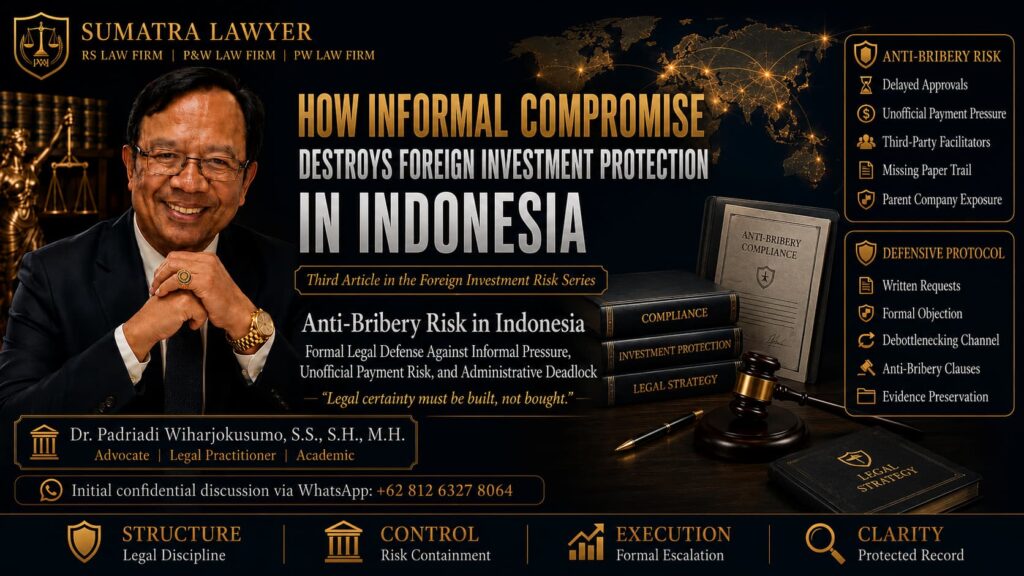
Anti-Bribery Risk in Indonesia is no longer a theoretical compliance issue for foreign investors.
It is a boardroom survival issue.
This is the third article in our analytical series on foreign investment risks in Indonesia. The first article examined the tension between Indonesia’s sovereign rights and the investor’s need for regulatory certainty. The second article moved further into governance risk, regulatory over-enforcement, administrative pressure, and formal legal defense. This third article addresses a more dangerous problem: how informal compromise at the local level can destroy the legal protection that foreign investors carefully build at the national and international level.
In Indonesia, many investment problems do not begin in court.
They begin in the field.
An environmental approval is delayed. A local operational recommendation is unclear. An RKAB-related matter becomes uncertain. A license is pending without transparent explanation. A regional administrative office becomes difficult to read. Local management begins to panic.
At that moment, the investor faces a critical choice.
Should the company respond through formal legal channels?
Or should it seek a “practical solution” through unofficial intermediaries, coordination payments, or informal arrangements?
For global investors, the second option may look fast. But legally, it is often fatal.
1. The Field Panic: When Local Pressure Triggers Bad Decisions
Foreign investors often build sophisticated structures in Jakarta, Singapore, Hong Kong, or other financial centers.
They prepare shareholder agreements, financing documents, compliance manuals, group reporting lines, anti-bribery policies, and risk allocation clauses. On paper, the structure looks disciplined.
But in practice, legal protection is often tested far away from the boardroom.
It is tested in a local office, during an inspection, in an informal conversation, or through a third-party “facilitator” who claims to know how to solve the problem quickly.
This is where panic becomes dangerous.
A delayed approval may be interpreted as a signal that “something must be arranged.” A stalled process may be treated as a normal cost of doing business. A vague administrative obstacle may push local managers to seek unofficial help without informing the legal or compliance department properly.
This is how Anti-Bribery Risk in Indonesia begins.
Not with a formal corporate decision.
But with an informal compromise that nobody wants to record.
2. The greatest danger of informal compromise is not only that it may violate the law.
The greater danger is that it destroys the company’s legal defense.
A formal objection creates a record.
An official letter creates a record.
A written request for clarification creates a record.
A report through a proper government channel creates a record.
But a backdoor arrangement creates silence.
There is no transparent document. No legal basis. No official reasoning. No accountable decision-maker. No procedural protection.
Once a company enters that dark room, it loses the ability to say clearly:
“We followed the law.”
It also becomes vulnerable to repeated demands. A company that pays once may be expected to pay again. A company that resolves one issue informally may find that the next issue becomes more expensive. A local compromise may become a long-term dependency.
This is why foreign investors should be extremely careful with words such as:
“coordination fee,”
“facilitation,”
“local arrangement,”
“field settlement,”
“unofficial support,”
or “practical solution.”
In legal practice, words like these can become evidence.
From the perspective of foreign investment protection, informal compromise is not a shortcut.
It is a trap.
3. The Global Domino Effect: From Local Payment to International Liability
Foreign companies operating in Indonesia do not only face Indonesian law.
They may also face anti-bribery laws in their home jurisdictions, bank compliance requirements, shareholder expectations, lender covenants, stock exchange disclosure rules, internal audit procedures, and reputational scrutiny.
For example, the U.S. Department of Justice and the Securities and Exchange Commission describe the Foreign Corrupt Practices Act as covering anti-bribery and accounting provisions, jurisdictional reach, foreign officials, proper and improper payments, successor liability, and the hallmarks of an effective corporate compliance program. (Department of Justice)
The United Kingdom’s official Bribery Act guidance also identifies key offences, including bribery of foreign public officials and the failure of commercial organisations to prevent bribery by associated persons. The guidance emphasizes prevention procedures such as proportionality, top-level commitment, risk assessment, due diligence, communication, monitoring, and review. (GOV.UK)
This matters because a local payment in Indonesia may not remain local.
It may travel upward.
It may appear in accounting records.
It may be reviewed by auditors.
It may be questioned by banks.
It may be discovered during due diligence.
It may affect merger, acquisition, financing, or listing plans.
It may trigger internal investigation.
It may become a disclosure problem for the parent company.
This is the global domino effect of local compromise.
A small payment at the operational level may become a major legal exposure at the international level.
4. Why Ring-Fencing Fails When the Parent Company Approves Informal Payments
In the second article, we discussed structural ring-fencing as part of foreign investment protection.
Ring-fencing is important because it separates operational risk, asset ownership, financing exposure, and group-level liability.
But ring-fencing cannot protect a company from its own misconduct.
If an informal payment is approved, funded, tolerated, or knowingly ignored by the parent company, the protective wall may collapse. A local problem can then contaminate the broader group structure.
This is the point many investors miss.
A holding company may believe that risk is isolated in a local subsidiary. But if the parent company controls the budget, approves the facilitator, receives reports, or benefits from the arrangement while ignoring red flags, the issue may no longer be local.
It becomes a group governance problem.
This is why Anti-Bribery Risk in Indonesia must be managed through more than contract drafting.
It requires corporate discipline.
Companies must define who may communicate with officials, who may appoint third-party agents, who may approve payments, who must escalate red flags, who reviews local invoices, and who preserves evidence when administrative pressure emerges.
Without this discipline, structure becomes decoration.
5. Defensive Protocol: Stop Talking, Start Documenting
When a foreign investor faces administrative deadlock, licensing pressure, RKAB uncertainty, local obstruction, or alleged informal payment demands, the first legal response should be simple:
Stop informal communication.
Start documenting.
This does not mean the company should become confrontational. It means the company should move the issue into a formal legal corridor.
The defensive protocol should include several steps.
First, all administrative requests should be asked to be made in writing. If an officer, intermediary, or local party claims that a requirement exists, the company should request the legal basis, authority, deadline, and formal procedure.
Second, the company should prepare a chronology. Every meeting, message, request, delay, verbal instruction, and document submission should be recorded internally.
Third, the company should issue formal letters when necessary. A written request for clarification, administrative objection, or legal notice may become crucial evidence if the matter escalates.
Fourth, the company should use formal escalation channels where available. As discussed in the second article, investment bottlenecks should be approached through documented and lawful channels rather than informal payments or private arrangements.
Fifth, all local vendors, agents, consultants, fixers, brokers, and community intermediaries must be controlled by strict anti-bribery clauses. The contract should clearly prohibit bribery, facilitation payments, undocumented government-facing expenses, and unauthorized communication with officials.
Sixth, legal counsel should review the matter before the company makes any payment that may be interpreted as unofficial, undocumented, or connected to the acceleration of government action.
This is not bureaucratic formality.
This is legal survival.
6. The Sumatra Lawyer Perspective
As a lawyer and academic based in Sumatra, I have seen how legal risk in Indonesia often emerges from the gap between formal regulation and local execution.
In resource-rich regions, the risk is not only whether a company has the right documents.
The deeper risk is whether local management can maintain legal discipline under pressure.
A foreign investor may enter Indonesia with excellent legal documents, strong capital, reputable advisers, and a sophisticated ownership structure. But one informal compromise at the local level may weaken everything.
This is why legal advisory for foreign investors in Indonesia must be practical, not merely theoretical.
It must prepare the company for pressure.
It must control communication.
It must protect the paper trail.
It must prevent panic decisions.
It must ensure that local execution does not destroy global protection.
That is the real meaning of Anti-Bribery Risk in Indonesia.
Conclusion: Legal Certainty Must Be Built, Not Bought
Foreign investors often ask how to obtain certainty in Indonesia.
The answer is not to buy certainty.
The answer is to build it.
Legal certainty must be built through structure, documentation, compliance discipline, formal escalation, and controlled execution. It cannot be purchased in the dark.
A company that pays for convenience may eventually pay with its legal protection.
Once an investor enters the dark room of informal compromise, every future demand becomes harder to resist.
For further analysis in this series, readers may review the earlier articles on Foreign Investment Risks in Indonesia and Foreign Investment Protection in Indonesia. Readers may also explore broader advisory perspectives developed through PW Law Firm Medan.
Facing Informal Pressure or Administrative Deadlock in Indonesia?
If your company is facing delayed approvals, unofficial payment requests, unclear administrative demands, RKAB uncertainty, licensing pressure, local regulatory obstruction, or third-party “facilitation” proposals, do not respond informally.
Build a formal legal record first.
Send a brief summary for an initial confidential discussion via WhatsApp:
WhatsApp: +62 812 6327 8064
Please include your company background, sector, location, chronology, involved administrative issue, available documents, and urgency level.
About the Author
Dr. Padriadi Wiharjokusumo is an Indonesian legal practitioner and academic based in Medan, North Sumatra, Indonesia. His work focuses on cross-border investment, corporate legal strategy, foreign investment structuring, regulatory risk, dispute prevention, anti-bribery exposure, and governance-related legal protection in Indonesia. His advisory approach is built around three core elements: structure, control, and execution.
Academic Disclaimer
This article is written for general academic and analytical purposes. It does not constitute legal advice and does not intend to accuse, judge, or represent any specific party, institution, official, company, or ongoing matter. Any company facing regulatory, administrative, fiscal, land, forestry, licensing, enforcement, or anti-bribery concerns in Indonesia should seek formal legal advice based on its specific documents, jurisdiction, sector, and factual circumstances.