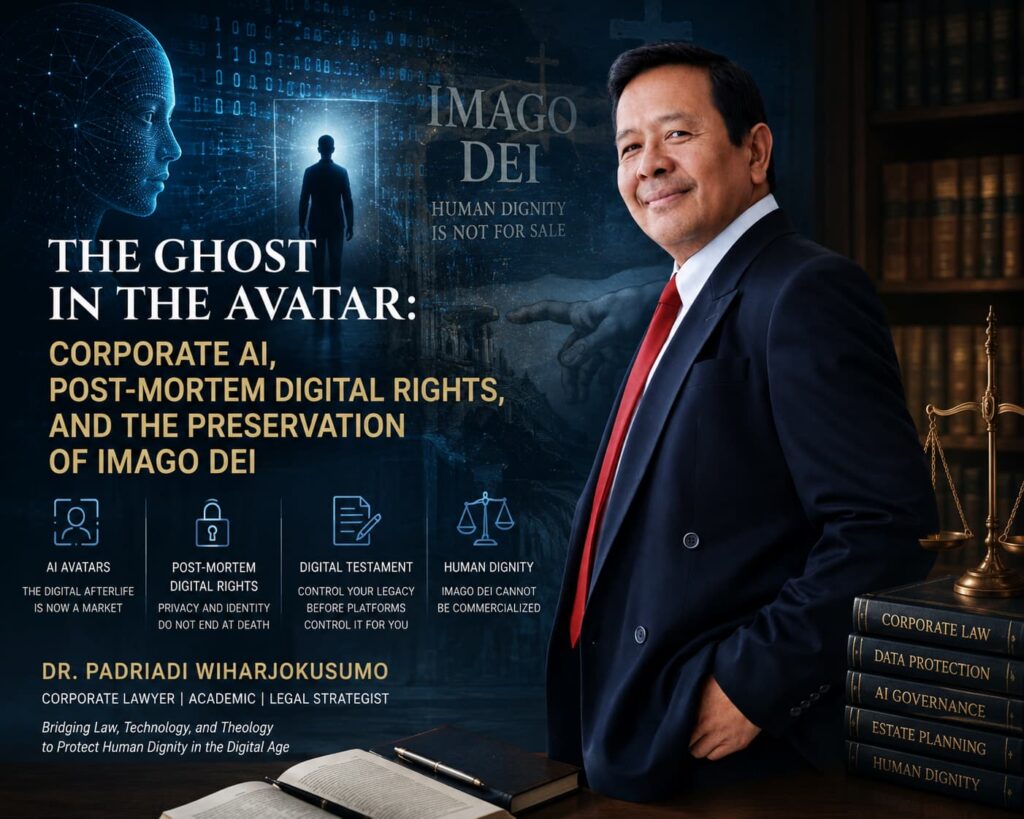
Introduction: The Commercialization of the Digital Afterlife
The convergence of generative artificial intelligence, immersive digital environments, biometric data, and platform-based capitalism has changed the way modern law understands human identity.
In my previous analysis, AI and Metaverse Regulation in Emerging Markets, I argued that if artificial intelligence represents the operational mind of digital civilization, law and theology must provide its moral compass. That argument now moves into a more sensitive and urgent frontier: the digital afterlife.
Technology companies are increasingly able to process personal data, voice patterns, images, behavioral logs, writings, messages, and biometric traces to create AI-generated replicas of human beings. These replicas may appear as chatbots, voice simulations, virtual avatars, or immersive digital personas that continue to interact with living users after the original person has died.
This is no longer merely science fiction. It is becoming a commercial market.
For a corporate lawyer and academic, this development raises a serious legal and moral question: when a person dies, who controls their digital likeness, memory, voice, and identity?
More provocatively, when corporate AI can simulate the dead, who protects the dignity of the person behind the data?
The Legal Problem: Post-Mortem Privacy and Corporate Control
From a traditional legal perspective, death terminates a person’s legal capacity. Estate law usually focuses on the transfer of property, debts, contractual rights, shares, land, bank accounts, intellectual property, and other legally recognized assets.
However, modern digital identity does not fit neatly into these categories.
A person’s digital life may include social media archives, cloud-based photographs, voice recordings, private messages, geolocation records, search behavior, biometric markers, and personal writing style. When these data points are processed by artificial intelligence, they can be transformed into a synthetic representation of the deceased person.
Indonesia’s Personal Data Protection Law provides an important framework for data protection. Still, it does not yet create a comprehensive and specific legal regime for post-mortem AI replicas, commercialized digital likeness, or the unauthorized use of a deceased person’s behavioral identity.
This regulatory gap creates a dangerous zone of corporate control.
Technology platforms often operate through complex Terms of Service. These contractual instruments may allow platforms to store, process, analyze, and monetize user-generated data across jurisdictions. In practice, platform contracts can function like private digital constitutions, governing the user’s identity long after the user has lost any practical ability to negotiate, withdraw, or object.
When a platform uses a deceased person’s digital footprint to train AI models or create monetized avatars, the legal issue is no longer limited to data management. It becomes a question of human objectification.
The OECD AI Principles emphasize that AI systems should respect human rights, democratic values, privacy, data protection, human agency, transparency, and accountability. Similarly, UNESCO’s Recommendation on the Ethics of Artificial Intelligence places human dignity, human rights, transparency, responsibility, and ethical governance at the center of AI development.
These principles are crucial. But they must be translated into enforceable legal structures before the market converts human memory into a subscription product.
The Theological Lens: Imago Dei and the Non-Commercial Nature of Human Dignity
The legal problem becomes even deeper when viewed through Christian theology.
The doctrine of Imago Dei teaches that human beings are created in the image and likeness of God. This means that human dignity is not produced by the market, granted by technology, or defined by corporate architecture. It is inherent.
Human identity is not merely a database.
Human memory is not merely an asset class.
Human likeness is not merely a monetization opportunity.
From this theological perspective, the human person cannot be reduced to behavioral patterns, voice samples, predictive responses, or platform-generated simulations. An AI avatar may imitate the speech, tone, appearance, and emotional style of a deceased person, but it does not possess real agency, moral consciousness, spiritual depth, or the sacred dignity of the original person.
This is where the phrase “digital soul” must be understood carefully. In legal and theological terms, a platform does not capture the soul. What it captures is a digital likeness: fragments of expression, conduct, memory, and identity. But even these fragments are morally significant because they are attached to a real human person.
The danger is not that AI can resurrect the dead. It cannot.
The danger is that corporations may create a market illusion of resurrection and then monetize grief, memory, and emotional dependency.
Recent academic and public discussions around AI “deadbots” and griefbots have raised concerns about consent, psychological harm, commercialization, and the dignity of deceased persons. These concerns are not abstract. They show that digital afterlife technology must be regulated before emotional vulnerability becomes a business model.
The Corporate Risk: When Digital Memory Becomes a Business Asset
For corporations, the digital afterlife raises serious governance questions.
If a technology company builds AI avatars from user data, who owns the resulting synthetic persona? Is it the estate of the deceased person? The heirs? The platform? The AI developer? The data processor? Or the commercial partner that deploys the avatar?
If the deceased person never gave clear consent, can the family authorize the creation of an AI replica? If some family members agree and others object, which interest prevails? If the avatar says something defamatory, misleading, religiously offensive, or commercially manipulative, who becomes liable?
These questions show why post-mortem digital identity cannot be treated as a simple intellectual property issue.
It involves privacy, inheritance, contract law, consumer protection, platform liability, AI governance, family rights, religious values, and human dignity.
For emerging markets, including Indonesia, the risk is even greater. Legal systems may be slower than technology platforms. Courts may not yet have clear doctrines. Regulators may not yet have specific rules. Families may not understand that by accepting a platform’s service, they may be allowing the commercial exploitation of a deceased loved one’s likeness.
This is precisely why legal structure must come before technological deployment.
Toward a Human-Centered Lex Digitalis
From a practitioner’s perspective, abstract ethical concern is not enough. Corporate AI and digital afterlife technology require enforceable legal architecture.
A human-centered Lex Digitalis should include at least four protective layers.
1. Digital Testament Clauses
Estate planning must evolve.
A modern will should not only regulate land, shares, bank accounts, family assets, and intellectual property. It should also regulate digital remains.
A digital testament clause should state whether the person permits or prohibits the post-mortem use of their image, voice, biometric data, writings, private messages, social media archives, or behavioral data for AI training, digital avatars, griefbots, holograms, or other synthetic representations.
Without this clause, families may face uncertainty while platforms continue to rely on broad contractual permissions.
2. Express Consent for Post-Mortem AI Use
Consent must be specific, informed, and traceable.
A general consent to use a digital platform should not be interpreted as consent to create a post-mortem AI replica. There must be a higher consent threshold for any technology that imitates the deceased person’s likeness, voice, personality, or emotional interaction.
This consent should be documented, revocable during life, and verifiable after death.
3. Injunctive Protection Against Unauthorized Digital Replication
Families and estates should have access to immediate legal remedies when a platform creates or commercializes an AI replica without proper authorization.
The remedy should include takedown rights, injunctive relief, damages, and audit access to determine how the deceased person’s data was processed, trained, stored, and monetized.
The right to likeness should not disappear simply because a person has died.
4. Algorithmic Accountability and Technical Safeguards
Technology developers must be required to build technical safeguards into AI systems.
AI platforms should be able to verify authorization before generating post-mortem replicas. They should maintain audit trails, source data records, consent logs, and restrictions against unauthorized persona generation.
This aligns with broader AI governance principles requiring transparency, accountability, human oversight, and risk management. The OECD AI framework emphasizes trustworthy AI and respect for human rights and democratic values, while UNESCO’s ethical AI framework reinforces the importance of human dignity and responsible governance.
Indonesia, Corporate AI, and the Future of Digital Identity Governance
Indonesia should not wait until post-mortem AI exploitation becomes a major dispute before developing legal safeguards.
As AI systems become more integrated into corporate services, social media, education, entertainment, finance, health, and digital legacy products, lawyers must begin asking deeper structural questions.
The issue is not only whether AI is innovative.
The issue is whether AI respects the boundaries of human personhood.
For companies operating in Indonesia or targeting Indonesian users, digital identity governance should be part of corporate compliance, data protection strategy, platform design, and contractual architecture.
For families, professionals, public figures, religious leaders, business owners, and academics, the protection of digital likeness should become part of estate planning.
For lawyers, this is an emerging field where corporate law, personal data protection, inheritance law, intellectual property, technology regulation, and moral philosophy will increasingly intersect.
This is also where legal strategy must move beyond documentation. It must protect the person behind the data.
Conclusion: The Human Person Must Not Become a Corporate Ghost
The digital afterlife is no longer a distant theory. It is becoming a commercial reality shaped by AI systems, platform contracts, biometric data, and emotional markets.
Innovation should continue. Artificial intelligence can support education, memory preservation, accessibility, and responsible historical documentation. But innovation must never be allowed to erase the sacred boundary between human dignity and corporate monetization.
The deceased person is not a product.
The family’s grief is not a retention strategy.
The human likeness is not an unlimited corporate asset.
The future may move deeper into virtual environments, but the human person must never be reduced to a corporate ghost inside an avatar.
A responsible legal order must protect post-mortem digital rights before technology transforms human memory into a permanent revenue stream.
For Indonesia, the task is urgent: build legal, contractual, and ethical safeguards now, before the market defines the rules by default.
About the Author
Dr. Padriadi Wiharjokusumo writes on corporate law, foreign investment strategy, digital governance, and emerging legal risks in Indonesia. His work combines academic legal analysis with practical experience in corporate and cross-border legal strategy.
For corporate legal strategy, AI-related governance risks, or digital identity structuring in Indonesia, readers may contact PW Law Firm Medan for a preliminary professional discussion.
Academic & Professional Disclaimer
This article is written for academic, educational, and general thought-leadership purposes only. It reflects an interdisciplinary legal, philosophical, and theological analysis of artificial intelligence, digital identity, post-mortem digital rights, and human dignity.
It does not constitute formal legal advice, legal opinion, or attorney-client representation. Specific legal issues involving corporate AI, personal data protection, digital estate planning, intellectual property, platform liability, or regulatory compliance in Indonesia should be reviewed based on the relevant facts, documents, jurisdiction, and applicable law.
For professional inquiries regarding corporate AI governance, digital identity protection, or strategic legal consultation in Indonesia, please contact:
PW Law Firm / Dr. Padriadi Wiharjokusumo
WhatsApp: +62 812 6327 8064
Email: pwlawfirmmedan@gmail.com