Foreign investment risk in Medan is not always created by a court judgment, regulatory sanction, police report, lawsuit, or visible business dispute.
For foreign investors operating in Medan, Sumatra, Indonesia, one of the most damaging legal risks may arise from something less visible: an unresolved criminal report that does not clearly move forward, does not formally end, and continues to cast a legal shadow over corporate assets, directors, financing, and business operations.
This is the problem of silent case closure.
For foreign investors operating in Medan, Sumatra, Indonesia, legal risk is often understood through visible legal events: a lawsuit, a police report, a regulatory sanction, a court hearing, or a final judgment.
But in practice, one of the most damaging legal risks may come from something less visible.
A case may not clearly move forward.
It may not formally end.
It may not reach prosecution.
Yet it continues to cast a legal shadow over corporate assets, directors, financing, and business operations.
This is the problem of silent case closure.
This article is the second part of a continuing series on Silent Case Closure and Corporate Legal Risk in Indonesia, with particular attention to how unresolved business-related criminal reports may affect corporate stability and foreign investment in Medan and the wider Sumatra region.
The first article, Silent Case Closure and Legal Uncertainty in Indonesian Business Disputes, examined the legal anatomy of silent case closure: a situation where a business-related criminal report does not clearly move toward prosecution, does not formally end through termination of investigation, yet continues to place the reported party under prolonged legal uncertainty.
This second article shifts the focus from procedure to economic impact.
It examines how unresolved criminal reports can freeze corporate assets, disrupt bank financing, delay strategic projects, weaken investor confidence, and turn productive business structures into legally uncertain assets.
The central question is no longer only whether a case has been formally closed or continued.
The deeper question is this:
How much economic value can be destroyed when a business case is left hanging without legal certainty?
The Hidden Economic Cost of Legal Limbo
In commercial disputes, particularly those involving land, plantations, mining, infrastructure, logistics, or regional business partnerships, a criminal report may remain unresolved for months or even years.
There may be no formal termination of investigation.
There may be no indictment.
There may be no final procedural position.
Yet the unresolved report continues to affect the company’s business reality.
For corporations, this is not merely a procedural inconvenience. It can become an economic trap.
A company may still legally own its assets, but those assets become commercially frozen. A project may still exist on paper, but financing, partnerships, and execution may stop. Directors may still hold corporate authority, but strategic decisions become hostage to legal uncertainty.
This is why silent case closure should not be understood only as a criminal procedure problem.
This concern is not merely local. The OECD’s Policy Framework for Investment places institutional quality, policy credibility, and the enabling environment for private investment at the center of investment policy analysis. From this perspective, legal uncertainty does not only affect one case; it affects how investors assess whether capital can be safely deployed, protected, and recovered in a jurisdiction.
It is also a corporate governance problem.
It is a financing problem.
It is an investment climate problem.
For investors entering or operating in Medan and Sumatra, the question is not only whether the business structure complies with Indonesian law. The deeper question is whether the structure can survive legal pressure when a commercial dispute becomes connected to a criminal process.
As discussed in Foreign Investment Legal Strategy in Sumatra, legal compliance is only one layer of protection. The more difficult question is whether the structure remains enforceable when it faces local pressure, partner conflict, or regulatory uncertainty.
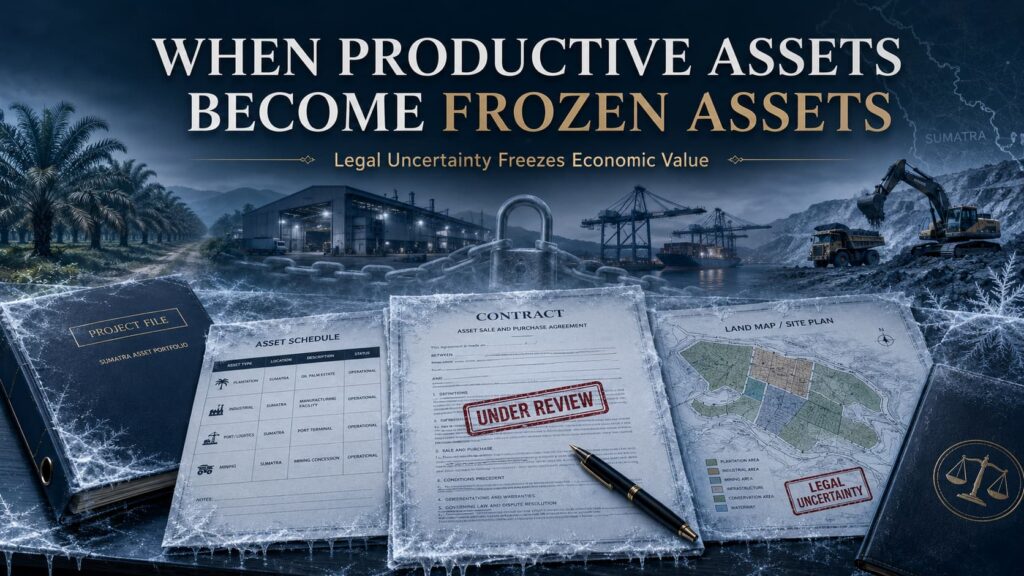
When Productive Assets Become Frozen Assets
In ordinary business disputes, parties expect conflict to move through a recognizable legal path.
A claim is filed.
Evidence is tested.
Arguments are heard.
A decision is issued.
The result may be painful, but it provides a legal point of reference.
Silent case closure works differently.
A criminal report may be submitted in connection with a business dispute. The reported party may be summoned. Documents may be requested. Corporate officers may be examined. The company may cooperate with the legal process.
But after some time, the process becomes unclear.
The case does not clearly proceed.
The case does not formally end.
The case remains present, but procedurally uncertain.
From the perspective of business, this creates a chilling effect.
Banks may become cautious. Credit facilities may be reviewed. Letters of credit may be delayed. International partners may request additional legal clarification. Buyers, suppliers, lenders, and joint venture partners may begin to question whether the project remains commercially safe.
This is how productive assets become frozen.
The company may still hold land rights, plantation assets, mining permits, machinery, contracts, receivables, or operational facilities. But those assets can no longer function at full economic value because the legal cloud surrounding the business creates hesitation among financial institutions, counterparties, and internal decision-makers.
This is especially dangerous in sectors where time is capital.
In plantations, delays affect harvesting, supply chains, land productivity, and working capital.
In mining, delays affect licensing, equipment deployment, contractor arrangements, export commitments, and investor confidence.
In infrastructure or regional development projects, delays may trigger cost overruns, financing pressure, and loss of commercial momentum.
The World Bank’s Business Ready framework assesses the business and investment climate by looking at the regulatory framework, public services, and operational efficiency. Its methodology also emphasizes the balance between formal rules and practical implementation, which is directly relevant when investors evaluate whether a jurisdiction can provide predictable business conditions.
From Civil Dispute to Criminal Pressure
In Indonesian business practice, not every commercial dispute remains purely civil.
A disagreement over payment, land control, asset transfer, corporate authority, partnership obligations, or contractual performance may later be framed as a criminal allegation.
This does not mean that every criminal report is abusive. Some reports may be legitimate and must be properly investigated.
The real problem arises when a criminal process becomes prolonged without a clear procedural direction.
At that point, the issue is no longer only whether the report is true or false. The issue becomes whether the unresolved legal process itself creates commercial damage.
This is particularly relevant in regional investment environments where formal contracts may intersect with land control, local permits, business relationships, operational access, and informal pressure.
Foreign investors often focus heavily on contracts, corporate documents, licenses, shareholder arrangements, and investment approvals.
These are essential.
But they are not always sufficient.
The OECD’s Investment Policy Review of Indonesia 2020 specifically emphasizes that investor protection is not limited to market entry rules. Property rights, contractual rights, legal guarantees, and efficient enforcement and dispute resolution mechanisms are also essential elements of a reliable investment framework. This is highly relevant when a commercial dispute is later connected to criminal allegations and begins to affect assets, directors, financing, and operational continuity.
A well-drafted contract does not automatically prevent a business partner from filing a criminal report.
A valid corporate structure does not automatically protect directors from repeated summonses.
A license does not automatically prevent local resistance from becoming legal pressure.
This is why legal strategy must be built before conflict escalates.
For companies operating in Medan, Sumatra, Indonesia, especially in land-intensive sectors, the legal structure must be stress-tested against criminalization risk, regulatory uncertainty, documentation weakness, and local enforcement dynamics.
This is part of the broader legal approach discussed in Corporate Disputes and Investment Risk in Indonesia.
The Corporate Damage Caused by a Stagnant Case
The damage caused by silent case closure may appear in several layers.
1. Banking and Financing Risk
When a company or its directors are connected to an unresolved criminal report, banks may become more conservative.
Even if there is no conviction, and even if there is no formal suspect status, the existence of an unresolved legal matter may trigger enhanced due diligence.
Credit disbursement may be delayed.
Collateral may be reviewed.
Loan restructuring may become more difficult.
New financing may be postponed.
Letters of credit may face additional scrutiny.
In business, financing is not only about legal ownership. It is also about confidence.
When legal uncertainty grows, financial institutions may not wait for a final criminal judgment. They may simply reduce exposure, delay decisions, or demand additional comfort.
2. Contractual and Partner Risk
International partners are often bound by strict compliance rules.
They may be required to evaluate whether an unresolved criminal matter creates reputational risk, anti-corruption risk, governance risk, or contractual exposure.
This can affect joint ventures, distribution agreements, offtake contracts, supply arrangements, construction contracts, and financing documents.
A foreign partner may not openly accuse the company of wrongdoing. But it may delay signing. It may request a legal opinion. It may suspend cooperation. It may activate internal compliance review.
In practice, this is enough to damage commercial value.
3. Governance and Director Liability Risk
Silent case closure also affects corporate governance.
Directors may need to repeatedly respond to summonses, prepare documents, attend examinations, and coordinate legal responses.
This diverts attention from business execution.
Board meetings may become defensive.
Strategic decisions may be postponed.
Expansion plans may be delayed.
Internal confidence may weaken.
For directors, the unresolved case becomes a continuing personal and corporate burden.
This is particularly serious where the company’s leadership must make fast decisions involving capital deployment, asset use, restructuring, land access, or investor negotiations.
A director operating under prolonged legal uncertainty may become overly cautious, even when commercial action is urgently needed.
4. Asset Productivity Risk
The most serious impact is the decline of asset productivity.
Land, plantations, mining concessions, machinery, project sites, permits, and contractual rights may remain legally registered under the company.
But their commercial value declines because the company cannot use them efficiently.
A plantation that cannot be managed properly loses productivity.
A mining project that cannot move forward loses investor confidence.
A logistics project that cannot secure financing loses timing.
A land asset under legal uncertainty becomes difficult to monetize, pledge, develop, or transfer.
In this way, silent case closure becomes a form of economic paralysis.
It does not always seize assets formally.
It freezes them practically.
Discretion, Due Process, and Undue Delay
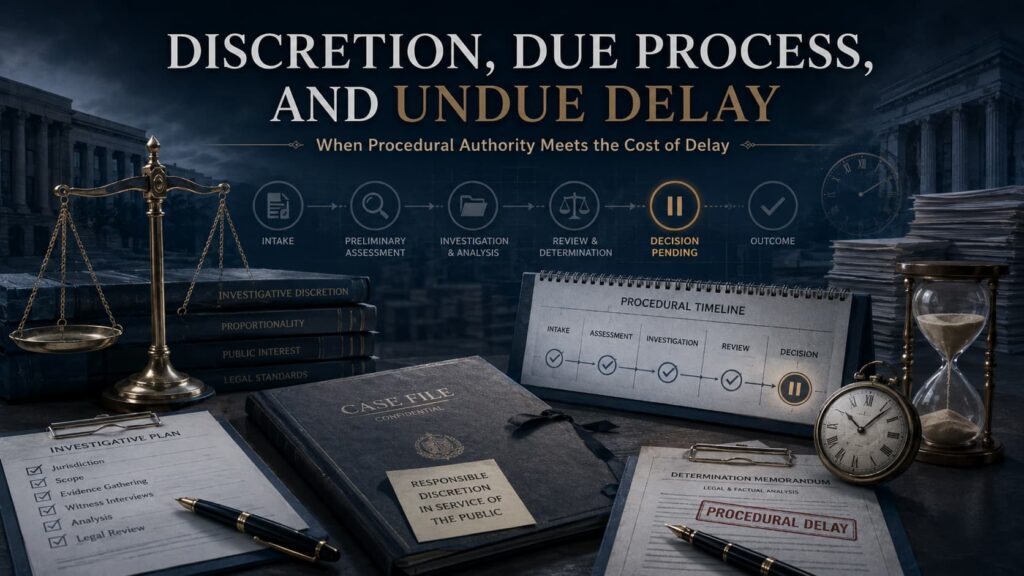
Investigators must have discretion.
Criminal investigation cannot be forced into artificial deadlines that ignore the complexity of evidence, witness examination, document review, forensic analysis, or legal assessment.
However, discretion cannot be understood as unlimited uncertainty.
This distinction is also consistent with the World Justice Project’s Rule of Law Index factors, which examine due process, regulatory enforcement, civil justice, criminal justice, and whether proceedings are conducted without unreasonable delay. For corporations, prolonged procedural uncertainty is not an abstract rule-of-law issue. It can directly affect financing, asset productivity, governance decisions, and investor confidence.
The legal issue is not whether investigators may examine a report carefully. Of course they may.
The deeper issue is whether an investigation may remain open-ended when its practical effect is to damage corporate value, freeze financing, weaken investor confidence, and paralyze business operations without formal legal certainty.
In Indonesia, the principle of justice being conducted in a simple, speedy, and low-cost manner has long been recognized as an important foundation of procedural justice. The concern is that delay can undermine justice when parties are left without a clear outcome; one discussion under Indonesia’s judicial framework expressly links slow proceedings with the idea that delayed justice may deny justice.
For business, this principle has a practical meaning.
A company needs to know whether it is facing a real criminal case, a civil dispute that has escalated into criminal pressure, or a matter that no longer has sufficient evidentiary direction but remains procedurally unresolved.
Legal uncertainty is not neutral.
It creates cost.
It creates hesitation.
It creates reputational exposure.
It creates financing pressure.
It creates strategic paralysis.
The longer the uncertainty continues, the more expensive it becomes.
Why Silent Case Closure Matters for Foreign Investment in Medan and Sumatra
Medan is one of the most important commercial gateways in Sumatra.
As a regional business hub connected to plantations, logistics, mining, energy, infrastructure, trade, and professional services, Medan plays a strategic role in how investors assess legal and operational risk in western Indonesia.
The region offers significant opportunities.
But opportunity alone does not move capital.
At the international level, UNCTAD’s World Investment Report 2025 shows that foreign direct investment remains highly sensitive to the broader investment environment, including the ability of economies to support productive capital flows. In this context, unresolved legal processes that freeze assets or weaken business confidence can become part of the risk calculation for foreign investors assessing Indonesia, Sumatra, and Medan as an investment destination.
Investment moves when opportunity is legally executable.
Foreign investors need more than market access. They need reliable structures, enforceable rights, predictable procedures, and legal support capable of responding when commercial conflict escalates into legal pressure.
This is where many investment structures are tested.
A project may appear strong at the signing stage.
The documents may look complete.
The licenses may appear sufficient.
The partnership may seem aligned.
But the real test comes later.
When a local dispute emerges.
When land access is challenged.
When a partner relationship breaks down.
When a regulatory process slows.
When a criminal report is used as leverage.
At that moment, the investor discovers whether the legal structure was built merely for compliance or for survival.
For this reason, corporate legal advisory in Indonesia should not be limited to company establishment, licensing, contract drafting, or basic compliance.
It must include dispute anticipation, criminalization risk mapping, documentation discipline, local regulatory analysis, procedural defense planning, and crisis-response strategy.
This is especially relevant for foreign investors considering or operating in Medan, Sumatra, Indonesia.
Defensive Strategy for Corporations
Companies cannot control every external legal process.
But they can control their internal preparedness.
A defensive legal strategy should begin long before a dispute reaches the police, the court, or the regulator.
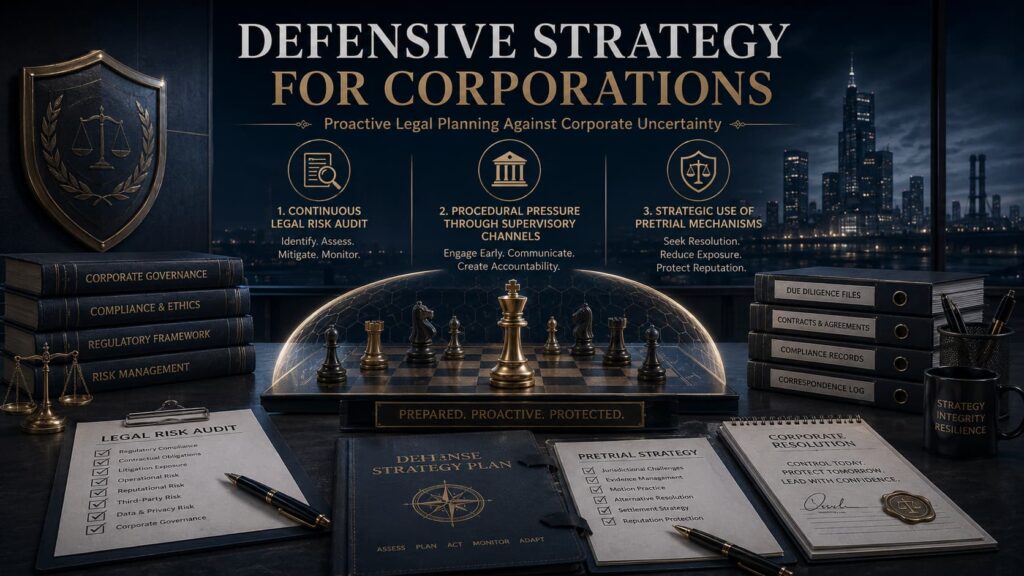
1. Continuous Legal Risk Audit
Modern investment protection is increasingly moving beyond dispute resolution after damage has already occurred. UNCITRAL’s work on investment mediation and dispute prevention reflects the growing importance of preventing and mitigating investment disputes before they destroy commercial value. For corporations operating in Indonesia, this supports a preventive legal strategy: document discipline, early risk mapping, structured communication, and timely procedural action before legal uncertainty becomes economic paralysis.
A company must maintain a strong evidence architecture.
This includes contracts, board approvals, shareholder resolutions, land documents, payment records, correspondence, licenses, tax documents, compliance records, operational reports, and internal decision-making records.
The purpose is not merely documentation.
The purpose is defensive clarity.
When a business dispute becomes connected to a criminal report, the company must be able to show that the matter is commercial in nature, properly documented, and supported by lawful corporate decision-making.
Weak documentation gives room for ambiguity.
Ambiguity creates legal pressure.
For investors, this means legal audit should not be treated as a one-time compliance exercise. It should be part of continuing corporate risk management.
2. Procedural Pressure Through Supervisory Channels
When a case becomes stagnant, corporations should not rely only on informal follow-up.
Formal procedural pressure may be necessary.
This may include written requests for case progress, formal clarification letters, requests for procedural certainty, or complaints through relevant supervisory channels where appropriate.
Depending on the nature of the delay and the conduct being questioned, companies may consider structured use of public complaint mechanisms, internal supervisory channels, Propam, Kompolnas, or Ombudsman.
The purpose is not to attack institutions.
The purpose is to request procedural clarity.
A professional legal strategy should always distinguish between criticizing undue delay and attacking the legitimacy of law enforcement.
The first may be necessary.
The second may create unnecessary counter-risk.
3. Strategic Use of Pretrial Mechanisms
Pretrial mechanisms must be used carefully.
Not every stagnant case can automatically be challenged through pretrial proceedings.
However, in certain circumstances, especially where there is a de facto termination, unclear procedural status, or concrete legal harm caused by investigative action, the possibility should be analyzed seriously.
The key is proportionality.
A pretrial strategy should not be used merely as a reaction.
It should be supported by a clear evidentiary record, procedural history, legal theory, and risk assessment.
For corporate clients, the question is not only whether a legal action is available.
The question is whether that legal action improves the company’s strategic position.
This is the difference between legal motion and legal strategy.
Policy Perspective: Why Procedural Certainty Matters
Silent case closure is not only a private problem between disputing parties.
It also raises a policy question.
How can a legal system protect investment if unresolved business-related criminal reports are allowed to remain unclear for too long?
Indonesia has made significant progress in digitalization, licensing reform, and investment facilitation. But investment confidence does not depend only on entry procedures. It also depends on dispute resolution, procedural certainty, and institutional responsiveness when business conflicts arise.
For regulators and law enforcement institutions, the issue is not to weaken criminal investigation.
The issue is to strengthen procedural accountability.
A case should move forward when there is sufficient basis.
A case should be formally closed when there is insufficient basis.
A reported party should not be left indefinitely under a cloud of uncertainty.
Digital case management, clearer procedural timelines, stronger supervisory review, and transparent communication of case status would help reduce uncertainty.
This would not only protect reported parties.
It would also protect legitimate complainants, investors, banks, partners, and the credibility of the legal system itself.
Conclusion: Legal Limbo Destroys Value Quietly
Seen from this broader international perspective, silent case closure is not merely a local procedural inconvenience. It intersects with globally recognized concerns about rule of law, investor protection, dispute resolution, regulatory predictability, and the preservation of economic value. For foreign investors, the question is not only whether Indonesia provides formal legal rights. The deeper question is whether those rights remain commercially meaningful when assets, directors, financing, and business operations are placed under prolonged procedural uncertainty.
For business, losing a case is painful.
But legal limbo can be more destructive.
A court decision gives a point of certainty.
A formal termination of investigation gives a point of closure.
Even an adverse legal outcome allows a company to calculate its next step.
Silent case closure gives none of that.
It freezes decisions.
It delays capital.
It weakens trust.
It damages reputation.
It turns productive assets into uncertain assets.
Over time, it may destroy commercial value without a single final judgment being issued.
This is why silent case closure must be understood as more than a procedural problem.
It is an investment risk.
It is a corporate governance risk.
It is a financing risk.
It is a threat to legal predictability.
For Indonesia, and especially for investment-driven regions such as Medan and Sumatra, legal certainty does not only mean clear regulations.
It also means clear procedural outcomes.
A case should move forward, or it should be formally closed.
What business cannot survive is indefinite uncertainty.
Need Strategic Legal Assessment in Indonesia?
If your company is facing an unresolved business-related criminal report, frozen assets, financing disruption, land-related conflict, or corporate legal uncertainty in Medan, Sumatra, Indonesia, early legal assessment is essential.
PW Law Firm provides strategic legal advisory for corporations, foreign investors, directors, and business owners dealing with complex legal, regulatory, and dispute-related risks in Indonesia.
For an initial confidential assessment, you may contact:
WhatsApp: +62 812 6327 8064
Please prepare a brief summary of the matter, relevant documents, timeline of events, parties involved, and the current procedural status.
About the Author
Dr. Padriadi Wiharjokusumo is an Indonesian legal practitioner and academic based in Medan, North Sumatra, Indonesia. His work focuses on corporate law, foreign investment strategy, business disputes, land-related conflicts, and legal risk management for companies operating in Indonesia, particularly in Sumatra.
Academic & Legal Disclaimer
This article is intended for academic and general legal analysis only. It does not refer to, accuse, or assess any specific company, individual, institution, investigator, law enforcement body, or ongoing case.
The discussion is based on general legal principles, professional experience, publicly available references, and recurring patterns of corporate legal risk in business-related disputes. It should not be interpreted as a factual statement, legal accusation, or legal opinion concerning any specific matter.
Companies, directors, investors, or individuals facing similar issues should obtain independent legal advice based on their own documents, facts, procedural history, and applicable Indonesian law.