
International Client Exposure & Cross-Border Legal Perspective
My connection with international clients began long before my legal career fully developed.
In my earlier professional years, I worked in Indonesia’s inbound tourism and expedition industry, engaging directly with foreign clients and international travel networks connected to the United States, Germany, Switzerland, France, and Singapore.
That experience included exposure connected with Pacto Tour & Travel Indonesia, SOBEK Expeditions USA, KUONI Switzerland, Neckermann Reisen Germany, and Universal Travel Corporation Pte Ltd, Singapore.
Those years shaped more than my professional experience.
They shaped how I understand trust, communication, timing, cultural expectations, operational discipline, international standards, and local execution on the ground.

Earlier exposure to Indonesia’s inbound tourism and expedition industry shaped Dr. Padriadi Wiharjokusumo’s understanding of foreign clients, operational discipline, and local execution.
Today, those lessons continue to influence my work as an Indonesian lawyer and legal academic advising foreign investors, tourism and hospitality businesses, international operators, and cross-border clients dealing with Indonesia, especially Sumatra.
Beyond Legal Titles
Legal titles are important.
Academic background is important.
Professional experience in courts, corporate matters, regulatory issues, and disputes is also important.
But for cross-border legal advisory in Indonesia, there is another layer that is often underestimated: the ability to understand how foreign clients think, how they assess risk, how they build trust, and how they respond when local realities do not match written expectations.
In my earlier exposure to Indonesia’s international tourism and expedition industry, I learned that foreign clients do not only evaluate a country through documents.
They evaluate people, timing, clarity, safety, consistency, communication, and execution.
They observe whether local partners understand international expectations. They assess whether information is reliable. They notice whether problems are anticipated or merely reacted to. They value discipline, transparency, and the ability to explain local realities without creating unnecessary alarm.
Those lessons remain relevant in legal practice.
Because in Indonesia, especially in Sumatra, many legal risks are not visible from documents alone.
From International Tourism to Legal Strategy
The tourism and expedition industry taught me that international work is never only about service.
It involves coordination, responsibility, cultural sensitivity, local knowledge, risk awareness, and the ability to manage expectations between foreign clients and Indonesian realities.
A foreign guest, expedition operator, travel company, or international partner may come to Indonesia with a clear plan. But on the ground, execution may depend on permits, land access, local authorities, community relations, timing, transport, safety, contractual clarity, and communication.
This is why tourism and hospitality should be understood not only as a business sector, but also as a field where legal, regulatory, environmental, and community issues often meet. Global institutions also recognize the wider economic and sustainability dimensions of tourism, including through UN Tourism’s investment work and the United Nations discussion on sustainable tourism.
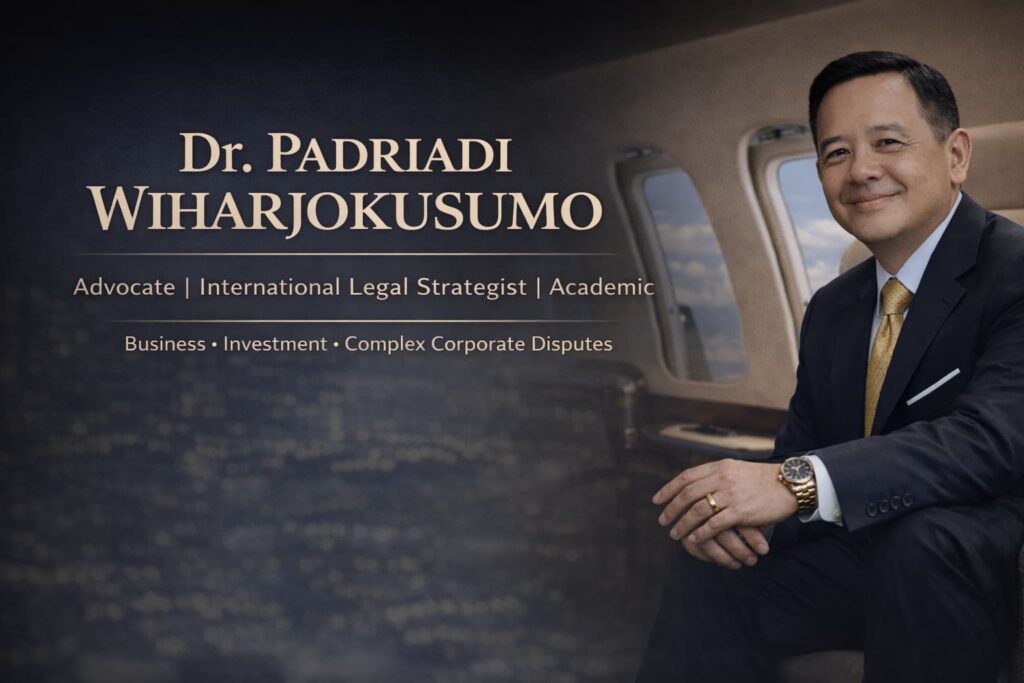
From international tourism exposure to legal strategy: Dr. Padriadi Wiharjokusumo’s earlier experience with foreign clients continues to shape his cross-border legal advisory perspective in Indonesia.
Years later, when my professional focus developed into Indonesian legal advisory, corporate advisory, foreign investment, regulatory matters, and dispute strategy, I realized that many of the same principles still apply.
Foreign investors may also come to Indonesia with a clear plan.
They may have documents, agreements, capital, business projections, and local partners.
But the real question is often different:
Can the structure survive local execution?
Can the legal position survive regulatory pressure?
Can the company maintain control when licensing, land, tax, administrative, or partner-related issues arise?
This is where my earlier international client exposure continues to shape my legal perspective.
Structure, Control, and Execution
My approach to Indonesian legal advisory is built around three core principles:
Structure.
Control.
Execution.
Structure means understanding the legal architecture before a client moves too far into documents, licensing, investment, land arrangements, contractual commitments, or administrative submissions.
Control means identifying who actually controls the asset, the company, the documents, the communication, the operational decisions, and the legal response when pressure appears.
Execution means understanding how legal plans are carried out in the real environment: before government offices, local authorities, business partners, communities, counterparties, regulators, and courts where necessary.
In Indonesia, legal risk is rarely only about what the document says.
It is often about whether the structure behind the document is strong enough to survive scrutiny, pressure, delay, conflict, and implementation challenges.
This is particularly important for foreign investors and cross-border clients dealing with Indonesia’s regulatory environment, land issues, corporate structures, licensing systems, tax exposure, administrative processes, and dispute risks.
For investment-related matters, Indonesia’s official investment and licensing ecosystem is closely connected with the role of Kementerian Investasi dan Hilirisasi/BKPM and the OSS risk-based licensing system. For foreign clients, however, submitting through a formal system is only one part of the process. The deeper issue is whether the legal and business structure behind the submission is strong enough.
In Indonesia, legal protection is not only about documents.
It is about whether the structure can survive pressure, whether control is properly secured, and whether execution can work under real local conditions.
That is the perspective I bring into cross-border legal advisory for foreign investors, tourism and hospitality businesses, international operators, and clients dealing with Indonesia, especially Sumatra.
PW LAW FIRM
Lawyers Who Know Sumatra